
One of the biggest concerns for spouses going through a divorce is how the home, car, savings, and company shares acquired during the marriage will be divided. Questions such as "The house is in my name, can my spouse still claim a share?", "Is the apartment I bought before marriage subject to division?", and "Can the spouse at fault in a divorce be denied a share of the property?" come up in almost every divorce case. In this guide, we walk you step by step through the participation in acquired property regime, the statutory property regime under the Turkish Civil Code (TMK), including which assets are subject to division, how the participation claim is calculated, how a property regime liquidation lawsuit is filed, and which time limits you need to watch.
Quick summary: For spouses who married after January 1, 2002 (or who have not entered into a property regime agreement), the statutory property regime is participation in acquired property. Assets acquired through work during the marriage are divided 50/50 on the basis of the net surplus value, regardless of whose name is on the title deed. Inheritances, gifts, and assets owned before the marriage are considered personal property and, as a rule, are not subject to division.
What Is Property Division in a Divorce?
Property division in a divorce, known legally as the liquidation of the property regime, is the process of calculating and paying out the spouses' rights and claims over the assets acquired during the marriage once the marital union comes to an end. Contrary to popular belief, property division is not an automatic consequence of the divorce case; when the court grants the divorce, it does not also divide the property. A separate lawsuit must be filed for property division. Even if this lawsuit is filed together with the divorce case, the court handles it as a separate file and does not conclude it until the divorce decision becomes final.
Under Turkish law, spouses may, before or during the marriage, enter into a property regime agreement before a notary and choose one of the regimes of separation of property, separation of property with participation, or community of property. In practice, however, since the vast majority of spouses do not make such an agreement, the statutory regime provided by law, participation in acquired property, applies.
Why Does the Date of Marriage Matter? Before and After 2002
The Turkish Civil Code No. 4721 entered into force on January 1, 2002. Under the former Civil Code in force before that date, the statutory property regime was separation of property; that is, each spouse was the sole owner of the assets registered in their name, and in a divorce the other spouse, as a rule, could not claim any share. For this reason, the date of marriage is the first thing to look at when determining property division:
- Those who married after January 1, 2002: The participation in acquired property regime applies for the entire period starting from the date of marriage.
- Those who married before January 1, 2002: The separation of property regime applies for the period up to January 1, 2002, and the participation in acquired property regime applies for the period from January 1, 2002 until the date the divorce case was filed. In other words, a house bought in 1998 by a couple who married in 1995 is, as a rule, the personal property of whoever is registered as the owner on the title deed, while a house bought in 2010 is subject to division.
For assets acquired in the earlier period, the other spouse's contributions can only be claimed through a contribution share claim lawsuit and provided that the contribution is proven, which is a much more difficult route than the automatic 50/50 division under the participation in acquired property regime.
Which Assets Are Subject to Division? Acquired Property vs. Personal Property
Under the participation in acquired property regime, the spouses' assets are divided into two groups. This distinction is at the heart of the division.

Acquired property (TMK Art. 219)
These are assets that each spouse obtains in return for consideration during the continuation of the property regime. The law lists them by way of example:
- Earnings in return for work (salary, wages, freelance income, commercial profit),
- Payments made by social security or social assistance institutions (retirement bonus, severance pay, insurance payments),
- Compensation paid for loss of earning capacity,
- Income from personal property (for example, rental income from an inherited shop),
- Assets replacing acquired property (money obtained from the sale of a car bought with salary).
Personal property (TMK Art. 220)
- Items serving solely the personal use of one of the spouses (clothing, a watch, a personal computer),
- Assets belonging to one of the spouses at the beginning of the property regime (a house, car, or savings acquired before marriage),
- Assets obtained through inheritance or other gratuitous acquisition (gifts),
- Claims for non-pecuniary damages,
- Assets replacing personal property (selling an inherited plot of land and buying an apartment in its place).
In practice, the point that causes the most disputes is assets from mixed sources. For example, if the down payment on an apartment bought during the marriage was paid from a spouse's inheritance and the remaining loan installments were paid from salary, the apartment has the nature of both personal and acquired property. In such cases, the court calculates the contribution ratio of each asset group and uses this ratio as the basis for liquidation. The spouse claiming that an asset was bought with personal property is obliged to prove this claim; otherwise, by law, all assets are deemed acquired property (TMK Art. 222).
| Asset | Nature | Subject to division? |
|---|---|---|
| Apartment bought with salary during the marriage | Acquired property | Yes, half of the net surplus value |
| Car bought before marriage | Personal property | No |
| Plot of land inherited from the mother | Personal property | No |
| Gold bought with the rental income of an inherited plot of land | Acquired property | Yes |
| Severance pay received during the marriage | Acquired property | Yes |
| Non-pecuniary damages received from a traffic accident | Personal property | No |
| Wedding jewelry and gifts | Personal property of the spouse to whom it belongs (Court of Cassation 2nd Civil Chamber, 2024: agreement, local custom, otherwise whoever it was given to) | No, subject of a separate jewelry claim lawsuit |
How Is the Participation Claim Calculated? Net Surplus Value Calculation
The participation claim is each spouse's half-share in the net surplus value of the other's acquired property. The calculation follows these steps in order:
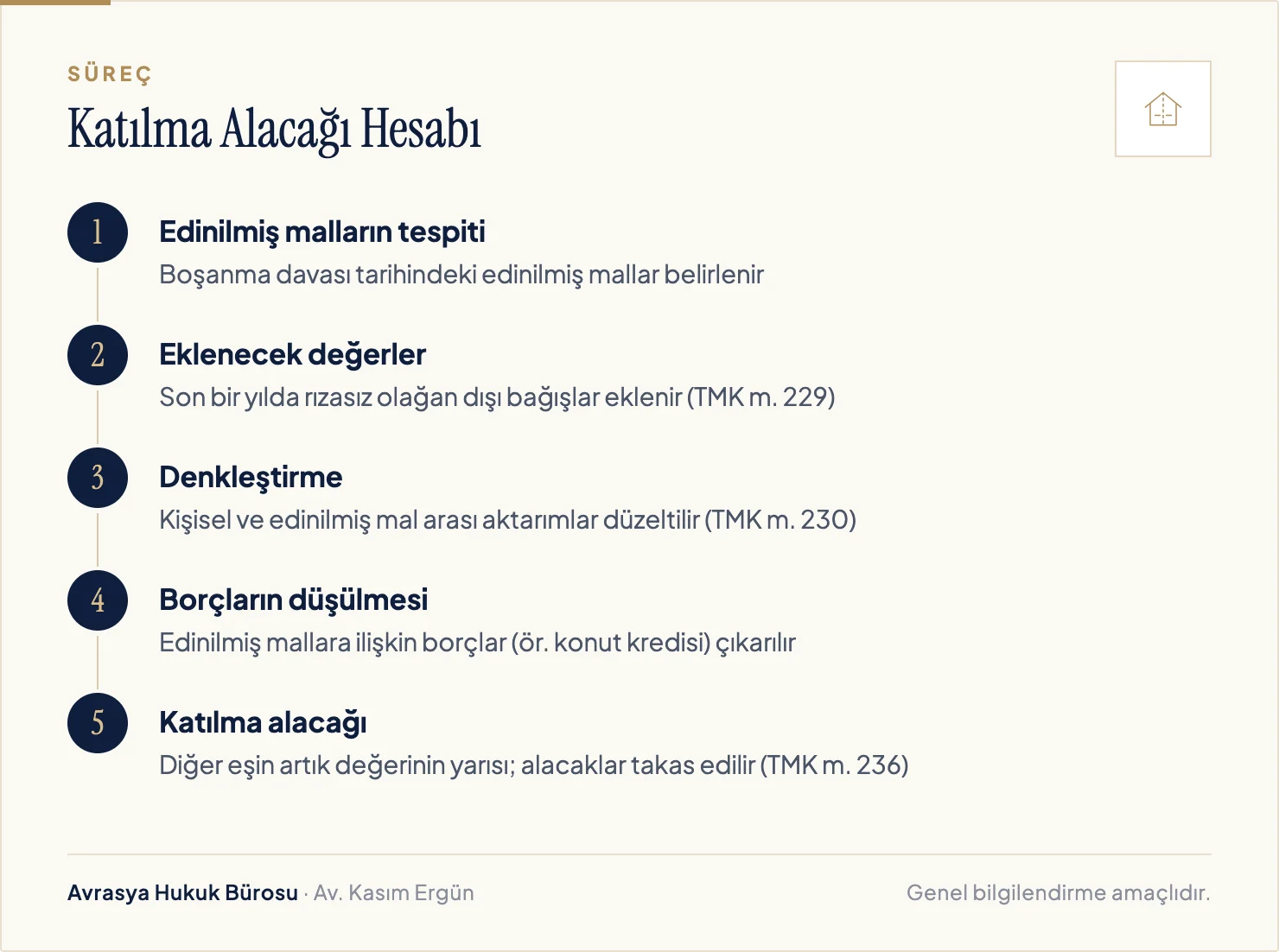
- Identifying acquired property: Each spouse's acquired property as of the date the divorce case was filed is determined.
- Values to be added back (TMK Art. 229): Extraordinary gifts made by one spouse without the other's consent within the year before the divorce case, and transfers made with the intent of reducing the other spouse's participation claim, are added to the calculation as if they were still part of the estate. Therefore, transferring the house to a sibling right before the divorce does not work.
- Offsetting (TMK Art. 230): Transfers from personal property to acquired property, or vice versa, are corrected.
- Deducting debts: Debts related to acquired property (for example, the remaining balance of a mortgage) are deducted.
- Net surplus value: The remaining amount is the net surplus value. If the net surplus value is negative, it is deemed zero; the debt does not pass to the other spouse.
- Participation claim: Each spouse has a claim to half of the other's net surplus value (TMK Art. 236). The spouses' mutual claims are set off against each other and the difference is paid.
Sample calculation
Ahmet and Ayşe married in 2010, and a divorce case was filed in 2025. On the date of filing, there is an apartment registered in Ahmet's name, bought with salary during the marriage and worth 6,000,000 TL on the liquidation date; 1,000,000 TL of mortgage debt remains on the apartment. Ayşe has a deposit of 400,000 TL registered in her name, saved during the marriage.
- Ahmet's net surplus value: 6,000,000 − 1,000,000 = 5,000,000 TL → Ayşe's participation claim is 2,500,000 TL
- Ayşe's net surplus value: 400,000 TL → Ahmet's participation claim is 200,000 TL
- After set-off, Ahmet will pay Ayşe 2,300,000 TL.
There are two critical dates to keep in mind. Which group an asset falls into and which assets are included in the calculation are determined according to the date the divorce case was filed (TMK Art. 225); assets acquired after the case is filed are not subject to division. However, the value of the assets is determined based on the time of liquidation, that is, the date closest to the judgment in the property regime lawsuit (TMK Art. 235). In periods of high inflation, this distinction significantly affects the amount of the claim.
The Participation Claim Is a Monetary Claim: "Who Gets the House?"
The answer to the frequently asked question "who gets the house in a divorce" surprises most people: the participation claim is a monetary claim, not a right in rem. In other words, a house registered in the husband's name on the title deed does not pass to the wife in a divorce; the wife becomes a creditor for money equal to half of the house's net surplus value. If immediate payment of the participation claim would cause serious hardship for the debtor spouse, the debtor spouse may request that payments be deferred for a reasonable period; unless otherwise agreed, interest accrues on the claim from the end of the liquidation, and security may be requested from the debtor if circumstances require (TMK Art. 239).
In addition, while the divorce case is ongoing, it is very important to have a family home annotation placed on the title deed to prevent the family home from being sold without consent, and to request a preliminary injunction when filing the divorce case to prevent the concealment or transfer of assets.
Does Fault Affect Property Division in a Divorce?
As a general rule, no. Property division is made based on the calculation of assets, not on fault in the divorce; a cheating spouse also receives their participation claim. However, TMK Art. 236/2 introduces an important exception: in the case of divorce due to adultery or an attempt on life, the judge may decide to reduce, in line with equity, or completely eliminate the at-fault spouse's share of the net surplus value. For this, the divorce case must have been filed on the basis of these specific grounds and the divorce must have been granted on these grounds; this exception does not apply to decisions issued on general grounds for divorce.
Property Regime Liquidation Lawsuit and Statute of Limitations
The competent court is the family court; in places where there is no family court, the civil court of first instance hears the case in that capacity. The property regime liquidation lawsuit can be filed at the same time as the divorce case; however, the court treats the finalization of the divorce decision as a preliminary matter. The lawsuit is subject to proportional court fees, and since the amount of the claim cannot be fully known at the outset, it can be filed as an indeterminate claim lawsuit and the claim can be increased after the expert report.
According to the Court of Cassation's established case law, participation claims and value increase share claims are subject to a 10-year statute of limitations, and the period runs from the date the divorce decision becomes final. For this reason, it is advisable to act without delay once the divorce becomes final.
Frequently Asked Questions
Can a homemaker spouse claim property in a divorce?
Yes. Under the participation in acquired property regime, it does not matter whether the spouse works or generates income. Housework and childcare are also considered contributions to the marital union; a homemaker spouse can claim half of the net surplus value of the other spouse's acquired property.
Are company shares divided in a divorce?
Shares in companies founded or acquired during the marriage are acquired property and are included in the calculation at their value on the liquidation date. A company owned before the marriage is personal property, but profits not distributed during the marriage and capital increases may have the nature of acquired property.
My spouse hid assets before the divorce. What can I do?
Extraordinary gifts made within the year before the divorce case and all transfers made with the intent of reducing the participation claim are added to the calculation. In addition, a lawsuit can also be filed against the third party who received the assets under certain conditions (TMK Art. 241). Requesting a preliminary injunction when filing the divorce case prevents further concealment of assets.
Is wedding jewelry (gold and gifts) included in property division?
Since the change in case law made by the Court of Cassation 2nd Civil Chamber in its decision dated 04.04.2024, No. E. 2023/5704, K. 2024/2402, wedding jewelry is no longer automatically deemed to belong to the wife. First, it is examined whether there is an agreement between the spouses; if there is none, the local custom and tradition that is asserted and proven is considered; if neither exists, the jewelry is, as a rule, deemed to belong to the spouse to whom it was given, and jewelry specific to one gender is deemed given to the spouse of that gender. Since the jewelry is the personal property of the spouse to whom it belongs, it is not included in the property regime liquidation; if it is not returned, it is claimed through a separate jewelry claim lawsuit.
How long does a property division lawsuit take?
Due to the wait for the divorce decision to become final, expert examinations, and records to be received from institutions, these lawsuits generally take between 1.5 and 3 years.
Conclusion
Property division in a divorce is made not according to the title deed records, but according to the distinction between acquired property and personal property set out by law and the net surplus value calculation. The date of marriage, the source from which an asset was acquired, the date the divorce case was filed, the value on the liquidation date, and the grounds for divorce directly affect the outcome. To avoid losing your rights, it is necessary to map out your assets and take the necessary precautions before filing for divorce.
Are you looking for legal support in your divorce and property division process? As Avrasya Law Office, we represent our clients in family law matters in Bakırköy. For an assessment tailored to your situation, request a preliminary consultation or explore our family law practice area.
This article has been prepared for general informational purposes and does not constitute legal advice. Since every case has its own unique circumstances, we recommend that you consult a lawyer for your specific situation.