What Is an Objection to a Decision of Non-Prosecution?
An objection to a decision of non-prosecution is a way of having the prosecutor's decision not to bring charges at the end of an investigation reviewed, not by the authority that issued it, but by an independent criminal judgeship of peace. The right to object belongs to the victim of the offense, and the time limit is two weeks from the date the decision is served on them. The rule is set out in Article 173 of the Criminal Procedure Code No. 5271 (CMK); the earlier wording of "fifteen days" was changed to "two weeks" by Law No. 7499.
A decision of non-prosecution (KYOK in Turkish) is the public prosecutor's determination, based on the evidence gathered, that there is not sufficient suspicion to file a public prosecution. This decision is issued under CMK Art. 172 and brings the investigation to an end.
When Is a Decision of Non-Prosecution Issued?
The prosecutor issues this decision if, at the end of the investigation, they conclude that there is not sufficient suspicion to warrant drafting an indictment. Common reasons in practice include:
- There is insufficient evidence that the suspect committed the offense,
- The act is not defined as an offense in law,
- The complaint, which is a condition for prosecution, is missing or has been withdrawn,
- There are obstacles to prosecution, such as the statute of limitations having expired, an amnesty, or the death of the suspect,
- There is a ground that justifies the act or removes culpability.
How Many Days Do You Have to Object?
The time limit is two weeks from the date of service of the decision (CMK Art. 173/1). This period is a forfeiture period; if it is missed, the objection is rejected on time grounds without examining the merits. The following points should be kept in mind when calculating it:
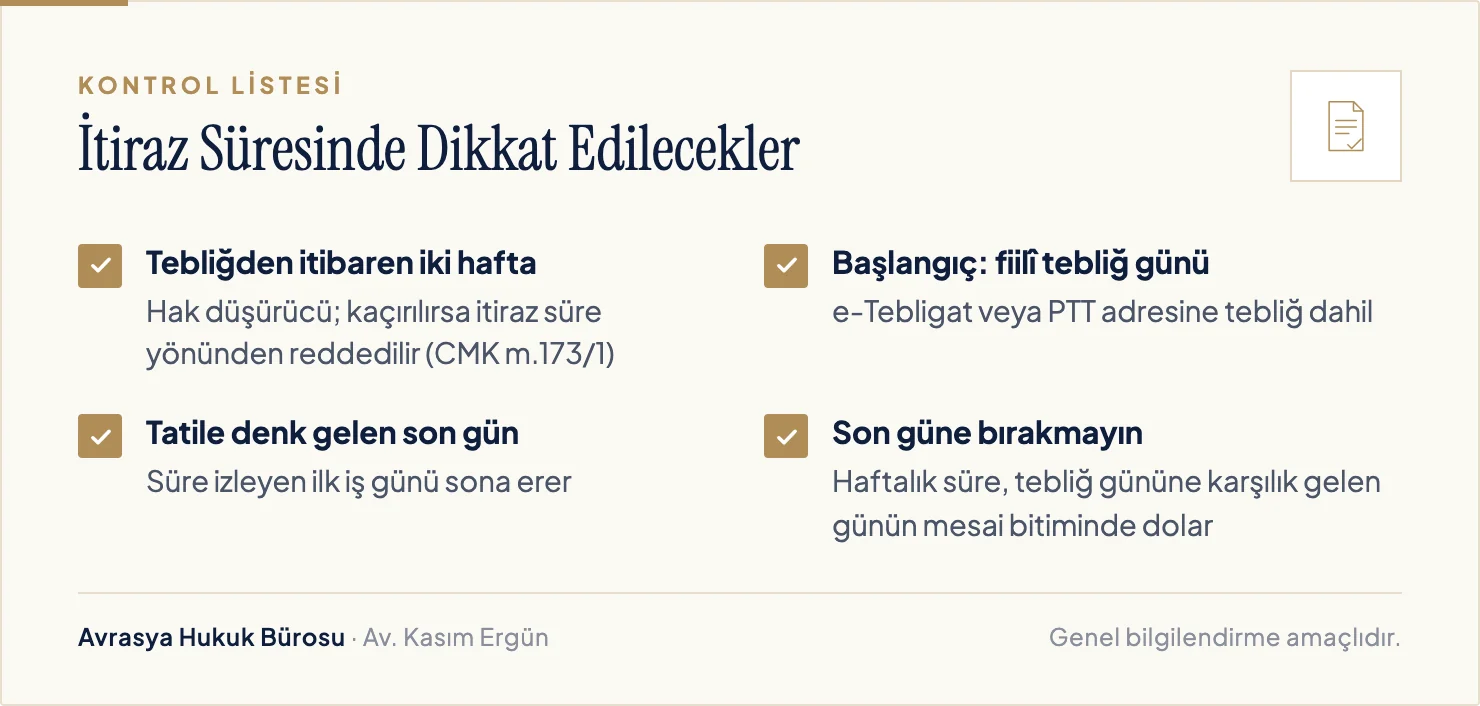
- A period set in weeks expires at the end of working hours on the same day of the week in the final week as the day on which service was made (CMK Art. 39/2); for example, for a decision served on a Monday, the period ends at the close of business on the Monday two weeks later. In the case of electronic service, notification is deemed to have been made at the end of the fifth day following the date the message reached the electronic address.
- If the last day falls on a weekend or an official holiday, the period ends on the next business day.
- What matters is that the petition is submitted to the competent authority, or handed to the post, within the time limit; leaving it to the last day is risky.
When Does the Period Start If the Decision Was Not Served?
If the decision was not properly served on the victim of the offense, the two-week period does not begin to run. In this case, the victim can find out the date of the decision and the service status from the prosecutor's office or through UYAP. The date on which they learn of the decision may take the place of service and start the period. For this reason, it is useful to document the date of learning.
What Should You Do If You Miss the Deadline?
If the deadline has been missed, two avenues may be considered:
- Restoration of the previous state: Under CMK Arts. 40 and 41, a person who let the period pass through no fault of their own may apply within two weeks of the obstacle ceasing to exist, documenting their reasons. Examples include serious illness or force majeure.
- New evidence: After a decision of non-prosecution, a public prosecution can be filed for the same act only if new evidence that creates sufficient suspicion is obtained and a criminal judgeship of peace rules on the matter (CMK Art. 172/2). Therefore, new evidence is submitted to the prosecutor's office by petition.
Who Has the Right to Object?
Under CMK Art. 173/1, the right to object to a decision of non-prosecution is granted to the victim of the offense. The victim is the person whose rights are directly violated by the offense; merely having filed a report does not confer this status. Therefore, an objection from a person who has not been directly harmed by the offense may be rejected on the grounds that they have no right to object. If the victim is a company or institution, it objects through its authorized representative or its attorney; in files handled by an attorney, service is made to the attorney and the period runs from that service.
Frequently Asked Questions
What Is the Time Limit for Objecting to a Decision of Non-Prosecution?
The time limit for objecting to a decision of non-prosecution is two weeks from the date the decision is served on the victim of the offense (CMK Art. 173/1, as amended by Law No. 7499).
How Is a Petition of Objection to a Decision of Non-Prosecution Written?
The petition of objection should be a text that clearly states the identity details of the objecting party, the details of the decision, and the grounds for the objection.
How Do You Object to the Criminal Judgeship of Peace?
The objection is made by a petition addressed to the criminal judgeship of peace located where the high criminal court within the jurisdiction of the public prosecutor who issued the decision sits. The petition sets out the events and evidence that could require a public prosecution to be filed (CMK Art. 173/2).
What Documents Are Required to Object to a Decision of Non-Prosecution?
Documents such as the petition of objection, a copy of the decision, and an identity document are required.
How Long Does the Objection Process Take?
How long the objection process takes depends on the court's workload; it is usually concluded within a few weeks.