
Divorce is the legal termination of a marriage and is based on specific grounds regulated under the Turkish Civil Code. The process follows two main paths depending on whether the parties reach an agreement: uncontested (agreed) divorce and contested divorce. The path you follow directly affects how long the process takes, what it costs, and vital outcomes such as custody, alimony, and the division of property.
What Is an Uncontested Divorce?
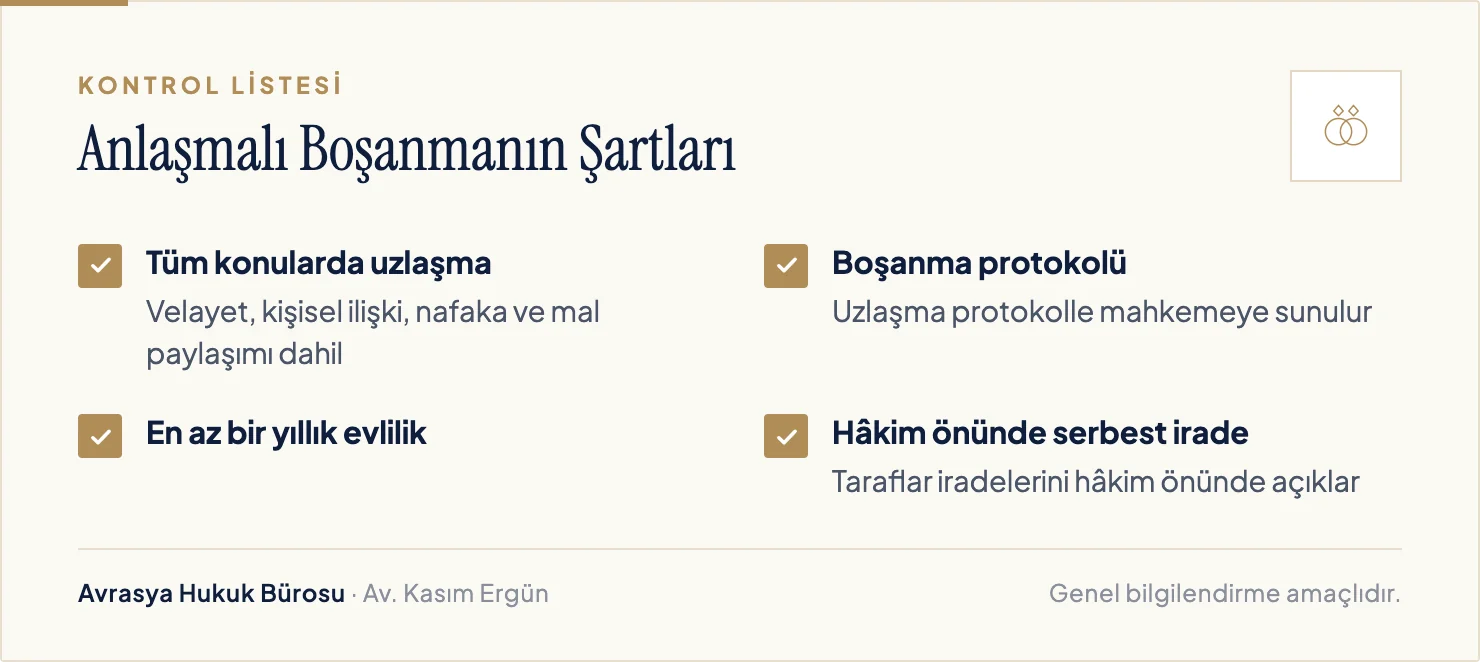
In an uncontested divorce, the spouses agree on every issue, including the divorce itself, custody, personal contact with the child, alimony, and the division of property, and they submit this agreement to the court in a divorce protocol. The marriage must have lasted at least one year, and the parties must freely express their will before the judge. When the protocol is properly prepared, the case is often concluded in a single hearing. For this reason, it is very important that the protocol is drafted completely and in a way that will not give rise to disputes in the future.
Contested Divorce and Fault
If the parties cannot agree, a contested divorce comes into play. Here, the case is based either on general grounds, such as the fundamental breakdown of the marriage (severe incompatibility), or on specific grounds such as adultery, attempt on life, or desertion. In a contested process, evidence and witnesses are decisive; the question of fault affects both compensation and alimony claims. Preparing petitions with sound legal reasoning, submitting evidence at the right time, and managing hearings well all shape the outcome.
Custody, Alimony, and Personal Contact
In deciding custody of a child, the court is guided by the best interests of the child; neither the mother nor the father is automatically favored. Personal contact (visitation days) is arranged between the child and the parent who is not granted custody. The types of alimony are as follows: interim alimony paid during the case, child support (contribution alimony) for the child, and poverty alimony for a spouse who would fall into poverty as a result of the divorce. Amounts are determined according to the parties' economic circumstances and needs.
Division of Property (Liquidation of the Marital Property Regime)
For marriages after 2002, the participation in acquired property regime applies as a rule. Accordingly, the value of property acquired during the marriage is, as a rule, divided equally; personal property such as inheritances and gifts is not subject to division. Because the date a property was acquired and each party's contribution affect the calculation, dividing property often requires a separate lawsuit and a careful calculation.
Documents Required for a Divorce Case and the Process
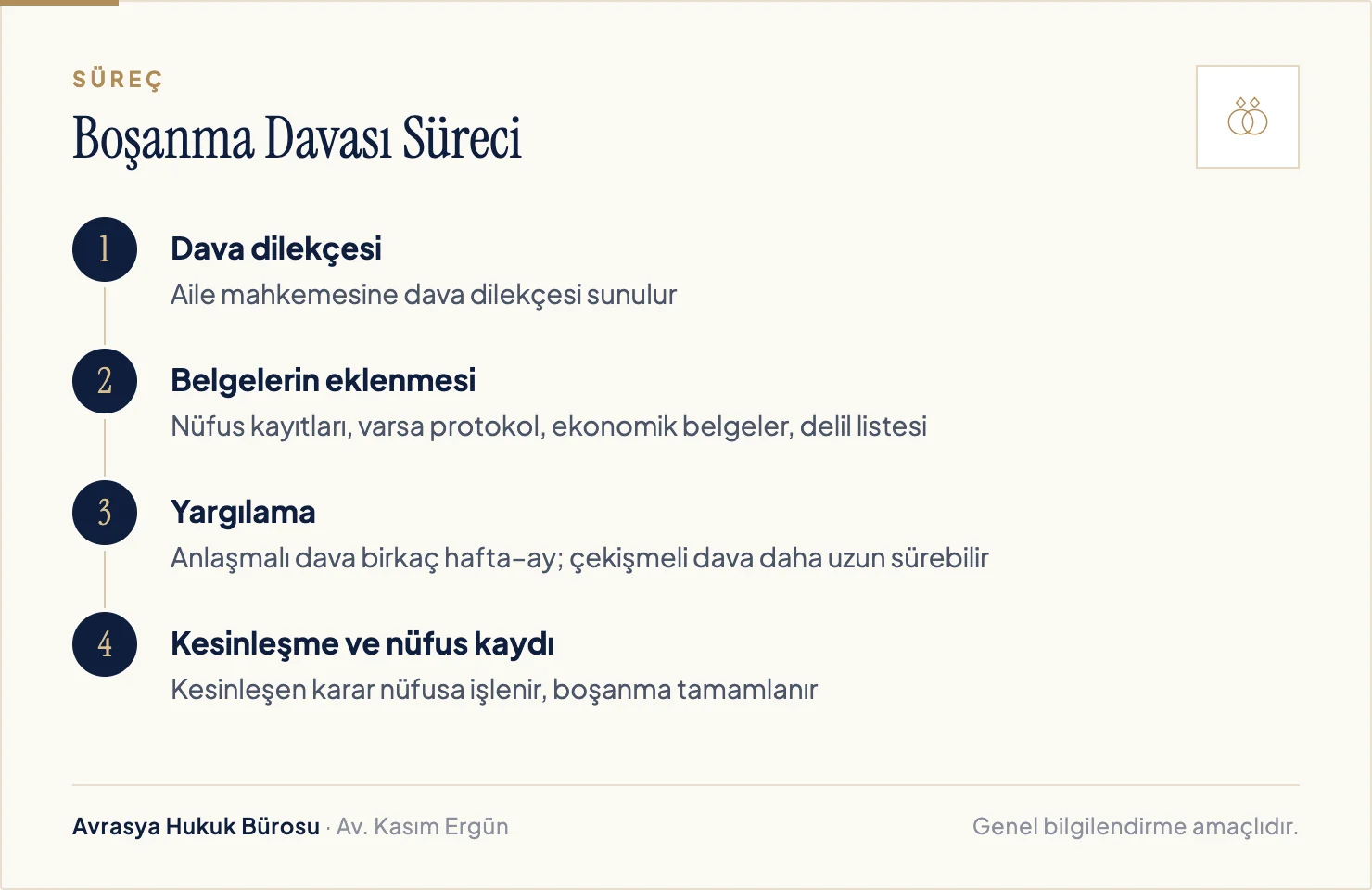
The case is opened with a petition submitted to the family court. Civil registry records, the protocol if there is one, documents showing financial status, and a list of evidence are added to the file. While an uncontested divorce can be concluded within a few weeks to months, contested cases may take longer depending on court workload and the state of the evidence. After the decision becomes final, it is recorded in the civil registry and the divorce is legally complete.
Pecuniary and Non-Pecuniary Compensation in Divorce
The spouse who is less at fault or not at fault in the events that led to the divorce may claim pecuniary compensation because their existing or expected interests have been harmed, and non-pecuniary compensation because their personal rights have been violated. The amount of compensation is determined by the parties' degree of fault, their economic circumstances, and the seriousness of the events. It is important that these claims are properly raised together with the divorce case; otherwise, a separate lawsuit may be necessary.
Who Owns the Wedding Gold and Jewelry?
On the question of who owns the gold and jewelry given at a wedding, the 2nd Civil Chamber of the Court of Cassation changed its earlier approach with its decision dated 04.04.2024, E. 2023/5704, K. 2024/2402. Jewelry is no longer automatically deemed to belong to the woman; instead, the following order is applied: First, it is examined whether the spouses had an agreement on the matter. If there is no agreement, and provided it is asserted and proven, the decision is made according to local custom and tradition. If neither exists, jewelry with economic value is, as a rule, deemed to belong to the spouse on whom it was worn or to whom it was given; however, jewelry specific to one gender is deemed to have been given to the spouse of that gender.
Where the jewelry has been sold or not returned, the entitled spouse may bring a jewelry claim lawsuit seeking return of the items in kind or, if that is not possible, their value. In such claims, proof is decisive: whom the jewelry was given to, who has kept it, and whether it was handed to the other spouse are established through evidence such as wedding footage, photographs, witness statements, and correspondence. Because the circumstances of each file differ, the state of the evidence and the rule that will apply to the specific case should be assessed before filing a lawsuit.
Common Mistakes
Preparing the protocol incompletely, failing to submit evidence on time, omitting alimony and property claims, or giving up rights because of emotional decisions are the most common mistakes. These mistakes can lead to consequences that are hard to reverse; therefore, handling the process with a family law attorney prevents loss of rights. The right strategy both shortens the process and protects your interests.
Uncontested or Contested? Making the Right Choice
If the parties can agree on every issue, an uncontested divorce is faster, less draining, and less costly. However, if there is a serious disagreement over custody, alimony, or the division of property, a protocol signed in haste may lead to a loss of rights down the road. At this point, a preliminary assessment with an attorney clarifies which path is truly right for you. Sometimes a short negotiation process can turn a contested case into an uncontested one and save months of time.
Post-Divorce Procedures
The process does not end when the divorce decision becomes final; matters such as updating civil registry records, the surname the woman will use, and the enforcement of custody and alimony come into play. If alimony is not paid, enforcement proceedings can be initiated; in addition, upon the creditor's complaint, a debtor who fails to comply with an alimony decision may be sentenced to coercive imprisonment of up to three months (Enforcement and Bankruptcy Law Art. 344). Getting legal support for any problems in enforcing the decision also ensures that your rights are actually realized.
Frequently Asked Questions
How long does an uncontested divorce take?
If the parties agree on all issues and the protocol is properly prepared, the case can often be concluded in a single hearing, within anywhere from a few weeks to a few months.
Are witnesses required in a contested divorce?
They are not required, but witnesses, messages, reports, and similar evidence are often decisive in proving claims. Evidence strategy directly affects the outcome.
Is custody always given to the mother?
No. The court is guided by the best interests of the child; age, the parties' circumstances, and the child's needs are assessed together.
How is a home purchased during the marriage divided?
As a rule, property acquired during the marriage is subject to liquidation of the marital property regime and its value is shared. The acquisition date and each party's contribution affect the calculation.
Which court do I file a divorce case in?
Divorce cases are heard in the family court. The competent court is generally the court of the place of residence of either spouse, or of the place where they have lived together for the past six months.
I am abroad. Can I file for divorce?
Yes. By granting a power of attorney, you can conduct the process in Turkey through your attorney; in a contested divorce case, many procedures do not require you to attend the hearing in person. In an uncontested divorce, however, because the judge must hear the parties in person (TMK Art. 166/3), you generally need to attend the hearing personally.
This content is for general informational purposes and does not constitute legal advice. For an assessment specific to your situation, you can request a preliminary consultation. As Avrasya Law Office, based in Bakırköy, we support individual and corporate clients.