An overtime pay claim is proven when the employee demonstrates that they worked the hours in question through evidence such as written documents or witnesses. As a rule, the burden of proof lies with the employee. Timesheets and entry-exit records, payrolls, messages, camera footage, and witness statements are used together for this purpose. An overtime claim is a wage claim that arises when the weekly statutory working time is exceeded and that must be paid at an increased rate. In this article, we summarize the types of evidence, the statute of limitations, and the litigation process within the framework of Labor Law No. 4857.
What is the difference between overtime and extra hours worked?
The Labor Law contains two separate concepts, and the pay rates differ.
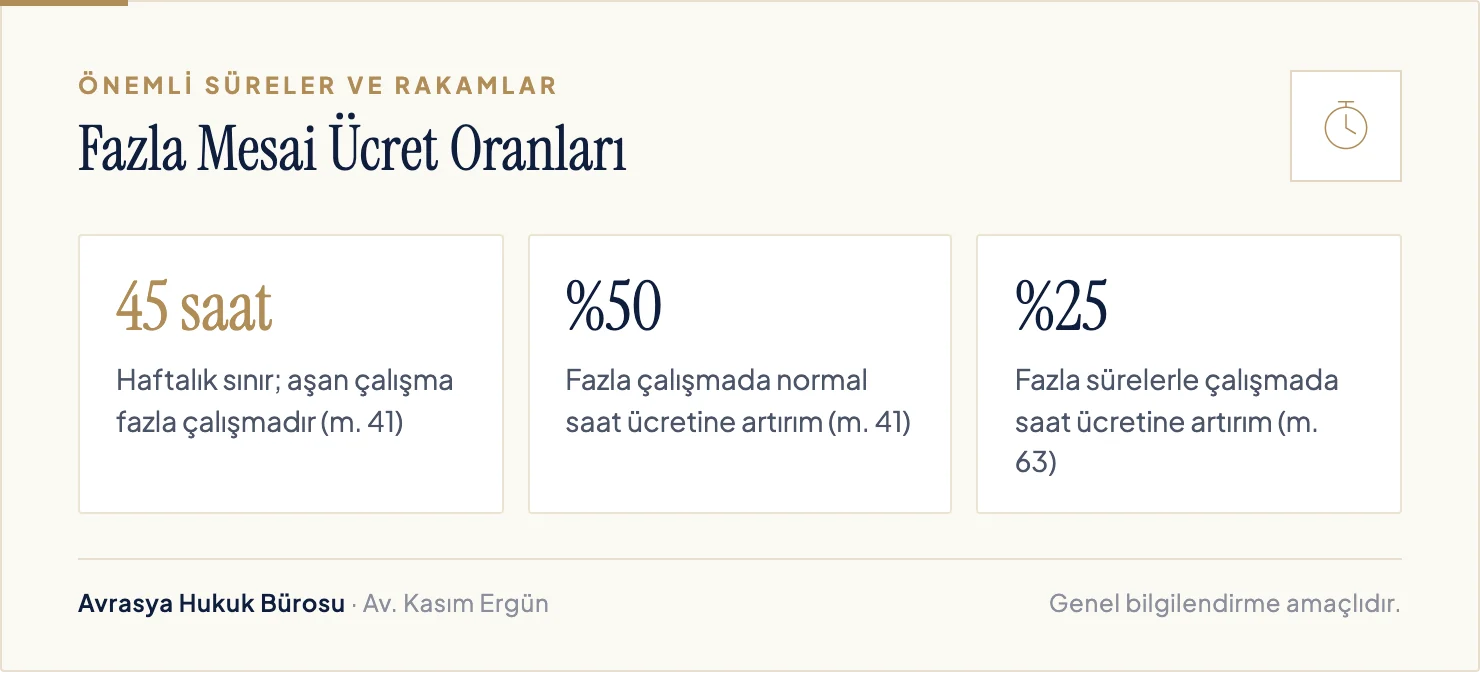
- Overtime (Art. 41): Work exceeding 45 hours per week under the conditions set out in the law. Each hour is paid with a 50 percent increase on the normal hourly wage.
- Extra hours worked (Art. 41/3): If the contract sets a weekly working time below 45 hours, this is work performed between that agreed time and 45 hours. Each hour is paid with a 25 percent increase on the hourly wage.
How Is Overtime Proven? Evidence
As a rule, the burden of proving that overtime was worked lies with the employee. The court looks at all the evidence in the file as a whole, not at a single document. The evidence most commonly used in practice is as follows:
- Payroll records: If overtime pay has been accrued in payrolls bearing the employee's signature, then under the Court of Cassation's practice, the employee must, as a rule, prove with written evidence that they worked more than what appears in the payroll. If a reservation of rights (objection) was noted on the payroll, additional work can be proven by any kind of evidence, including witnesses. This limitation does not apply to unsigned payrolls or payrolls with no overtime accrual; amounts found to have been paid are deducted from the overtime determined through witness statements.
- Timesheets and entry-exit records: Card access systems, fingerprint records, shift schedules, and timesheets bearing the employee's signature are strong written evidence.
- Witness statements: It is important that witnesses worked at the same workplace during the same period and personally observed the working hours. The statements of witnesses who have a lawsuit against the employer are taken into account to the extent that they are supported by other evidence. When overtime is determined through witness statements, a discretionary reduction may be applied to the calculated amount in practice.
- Correspondence and digital records: Emails sent outside working hours, work-related messages, system logs, and camera footage support other evidence if they were obtained lawfully.
- The employee's own notes: Work schedules kept unilaterally by the employee are generally not considered sufficient on their own; however, they may be taken into consideration when supported by witnesses and other records.
Statute of Limitations
Overtime pay is a wage claim and, under the last paragraph of Article 32 of the Labor Law, is subject to a five-year statute of limitations. The limitation period begins to run when the claim becomes due (Turkish Code of Obligations Art. 149). Because overtime pay must be paid together with the wages for the period in which the work was performed, the period runs separately for each month's claim from the date on which that month's wages were due; the date of the demand is not the basis.
Therefore, claims relating to the period more than five years back from the date of filing the lawsuit or the mediation application cannot be claimed if the employer raises a statute-of-limitations defense. The court does not take the statute of limitations into account on its own; the employer must raise it in due time. The limitation period is suspended from the application to the mandatory mediation office until the date the final report is issued. Since a lawsuit can also be filed while the employment contract continues, it is important to act without delay so that claims do not become time-barred.
The Litigation Process Step by Step
- Mandatory mediation: For employee claims such as overtime pay, applying to a mediator before filing a lawsuit is a prerequisite for the case (Labor Courts Law No. 7036 Art. 3). The application is made to the mediation office at the other party's place of residence or the place where the work was performed. A lawsuit filed without applying to a mediator is dismissed on procedural grounds.
- Lawsuit before the labor court: If no agreement is reached in mediation, a lawsuit is filed before the labor court (or, where none exists, before the civil court of first instance acting as a labor court) by attaching the original or a certified copy of the final report. The competent court is the court of the defendant's place of residence or the place where the work was performed (Law No. 7036 Art. 6). The simplified trial procedure applies in labor courts.
- Action for an indeterminate claim: Because the amount of overtime often cannot be determined precisely without examining witness statements and records, the lawsuit may be filed as an action for an indeterminate claim under Article 107 of the Code of Civil Procedure (HMK). In this case, the claim is clarified through an increase of the demand after the expert report.
- Collection of evidence and expert calculation: The court obtains workplace records and Social Security Institution (SGK) records and hears witnesses; then an expert calculates the overtime hours and pay according to the proven working pattern. The parties may object to the report.
- Decision and appeals: Subject to the monetary limits set by law, the court's decision may be appealed to the regional court of appeals (istinaf), and the appeal decision may be taken to the Court of Cassation (temyiz) if the conditions are met.
How Is Overtime Pay Calculated?
The basis of the calculation is the employee's bare hourly wage. For each hour exceeding 45 hours per week, an amount increased by fifty percent over the normal hourly wage is paid for overtime (Labor Law Art. 41/2). If the weekly working time is set below 45 hours by contract, an amount increased by twenty-five percent over the hourly wage is paid for extra hours worked that exceed this time and are performed up to 45 hours (Art. 41/3). If the employee wishes, instead of increased pay, they may take one hour and thirty minutes of paid time off for each hour of overtime, and one hour and fifteen minutes for each hour of extra hours worked (Art. 41/4).
Total overtime cannot exceed 270 hours in a year (Art. 41/8). However, this limit is a prohibition directed at the employer; if work exceeding the limit was actually performed, the corresponding pay may also be claimed. The calculation also takes into account whether averaging (equalization) was applied, rest break periods, and whether the contract contains a provision stating that overtime pay is included in the wage.
Frequently Asked Questions
How is an overtime pay claim proven?
As a rule, the burden of proving overtime lies with the employee. Entry-exit and timesheet records, payrolls, overtime approval documents, correspondence, and witness statements are evaluated together; the employee's own notes are generally not considered sufficient on their own. If signed payrolls include overtime accrual, work beyond what appears in the payroll must, as a rule, be proven with written evidence.
Which documents are required for overtime?
The documents required for overtime include the employment contract, overtime approval forms, time records, and, if available, email correspondence.
What is the statute of limitations for an overtime pay claim?
Because overtime pay is a wage claim, the limitation period is five years (Labor Law No. 4857 Art. 32). The period runs not from the date of the demand but separately for each month's claim, starting from the date on which that month's overtime pay was due, that is, became payable (Turkish Code of Obligations Art. 149). Therefore, claims relating to the period more than five years back from the date of filing the lawsuit or the mediation application cannot be claimed if the employer raises a statute-of-limitations defense; during the mandatory mediation process, however, the limitation period is suspended.
How is an overtime lawsuit filed?
Before filing a lawsuit for an overtime pay claim, applying to a mediator is mandatory; mediation is a prerequisite for the case (Labor Courts Law No. 7036 Art. 3). If no agreement is reached in mediation, a lawsuit is filed before the labor court together with the final report, and the evidence is submitted with the petition.
What stages does an overtime lawsuit involve?
The process generally consists of the mandatory mediation application, filing a lawsuit before the labor court if no agreement is reached, submission of evidence, an expert calculation when necessary, the hearing, and the decision; legal remedies may be pursued against the decision.