Many foreign nationals who want to join their family in Turkey, take up a job offer or simply visit again first learn that a restriction code (tahdit kodu) has been recorded against them at a consulate, while waiting for a visa decision, or at a border gate. The most common mistake at this point is to search the code online and conclude "I can never enter Turkey again" or "I have definitely been deported". In reality, a restriction record, an entry ban, a prior-authorization requirement, a visa refusal, a residence permit refusal and a deportation order are separate administrative acts, each with its own legal basis, remedy and deadline. This guide explains what a restriction code is, how to tell these acts apart, and which remedies are available while you are outside Turkey.
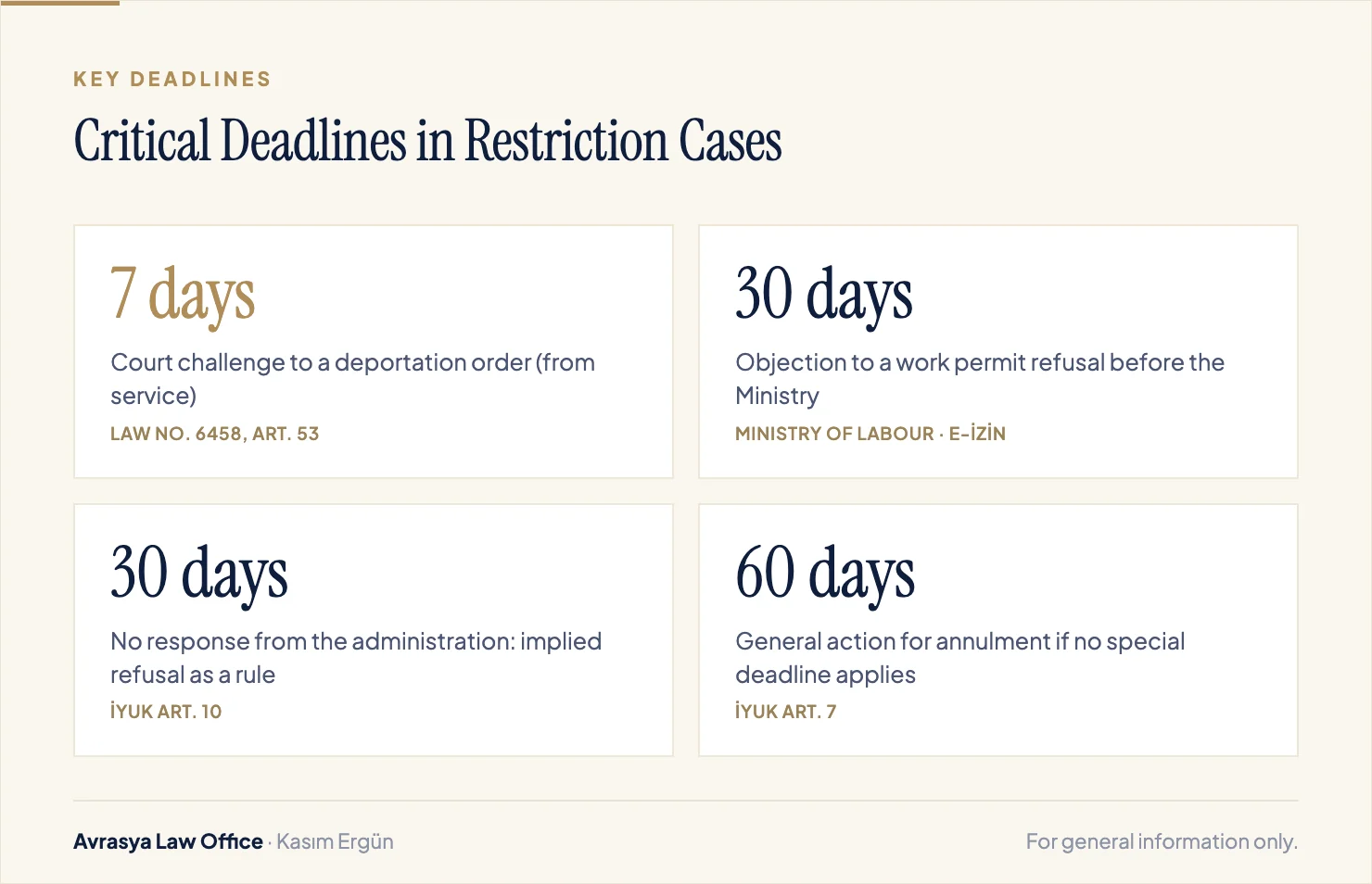
Short answer: A restriction code is a record or marker used in administrative procedures concerning foreign nationals; not every code means an entry ban or a deportation order. The right legal route is determined not by the name of the code but by the type of the underlying decision, its grounds and the date it was served. Being abroad does not by itself prevent you from filing an administrative application or a lawsuit in Turkey, but different deadlines apply: 7 days to challenge a deportation order, 30 days to object to a work permit refusal and 60 days for a general action for annulment.
What Is a Restriction Code (Tahdit Kodu)?
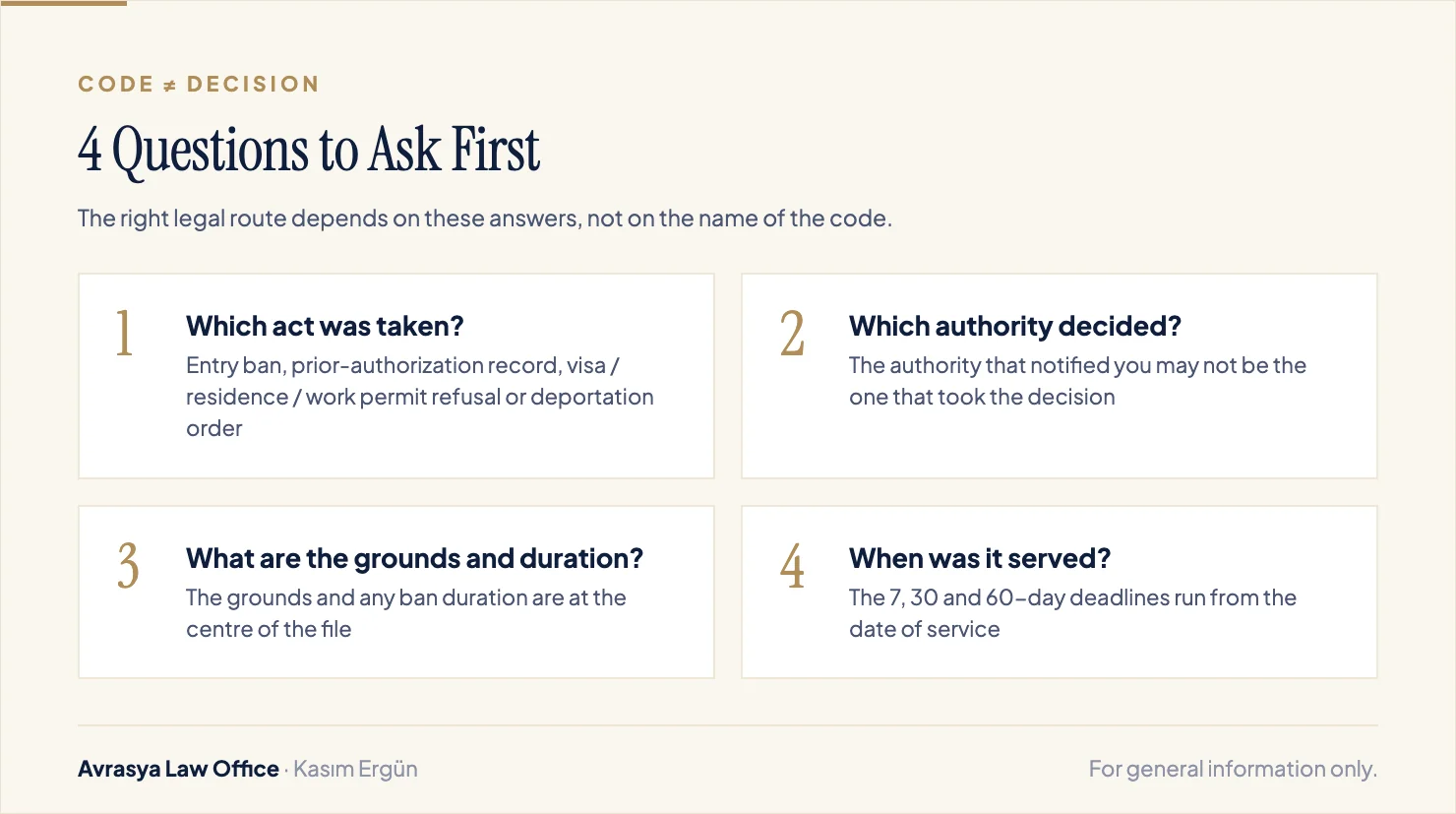
Restriction codes are records entered into the system to mark a person's status in administrative procedures concerning foreign nationals. The legal effect of a code is not fixed: it depends on the type of code, the decision it is based on and the person's specific circumstances. Some records prevent entry into Turkey, while others require the approval of the competent authority when entry or a visa application is assessed.
The first question to ask is therefore not "What is my code?" but "Which decision was taken about me, when, and on what grounds?" The mere existence of a code does not justify the conclusion that a person can never enter Turkey or will necessarily be deported.
Restriction Record, Entry Ban, Prior Authorization and Refusals: The Differences
Most of the confusion in practice comes from treating acts that look similar as if they were the same. The table below helps you distinguish the acts that are most often confused:
| Act | What it affects | Key point |
|---|---|---|
| Restriction record / code | A marker in the administrative system | It does not state an outcome on its own; the underlying decision must be identified separately. |
| Entry ban | Entry into Turkey | An administrative act preventing the foreign national from entering; its duration and grounds matter. |
| Prior authorization (istizan) record | The entry or visa assessment | It does not ban entry by itself; it means the approval of the competent authority is required. |
| Visa refusal | The visa required to enter Turkey | The refusal letter and its grounds must be reviewed separately. |
| Residence / work permit refusal | Staying and working in Turkey | Each has its own objection and court remedy. |
| Deportation order | Removal from the country | A special 7-day deadline from service applies to court challenges. |
A favourable outcome regarding one of these acts does not necessarily remove the others. For example, the annulment of a refusal decision may not automatically delete a restriction record that rests on a different basis.
The Legal Framework of Entry Bans
Entry bans are regulated in Article 9 of Law No. 6458 on Foreigners and International Protection. Under the Law, foreign nationals deported from Turkey are banned from entering, and an entry ban may also be imposed on those whose entry is considered objectionable for reasons of public order, public security or public health. As a rule, an entry ban may last up to five years; where there is a serious threat to public order or public security, the Presidency of Migration Management may extend it by up to ten more years. The Law also allows the administration to lift an entry ban or to permit entry for a specific period without lifting the ban.
This framework explains why "the duration of the ban" and "the grounds of the ban" sit at the centre of every file: the route to follow is largely shaped by these two pieces of information.
Old and New Codes: Why Conversion Lists Should Be Treated with Caution
Code lists circulating online cannot by themselves explain a foreign national's current legal position. Without a publicly available and verified official correspondence document, it is not correct to state definitively that "the old code has been replaced by this new code". Moreover, the removal of a record and the creation of a new record on different grounds are not the same thing.
When comparing old and current records, the following information should be relied on:
- The full name and number of the code,
- The date of the act and the authority that issued it,
- The grounds of the decision,
- The duration of any ban,
- The service (notification) details.
What to Watch for When Assessing Common Codes
N-82
The N-82 record is assessed in terms of making entry into Turkey subject to prior authorization. The administrative explanations cited in the Constitutional Court's Amanda Jolyn Krause and Others judgment show that this record is not the same as an entry ban decision. Nor can it be said that every N-82 record stems from a past visa or residence violation.
G group and G-87
The legal consequence of these codes must be examined on the basis of the information and documents relied on in the specific case. No criminal accusation should be made against a person based on the name of the code; the grounds of the decision and any related judicial and administrative documents must be assessed together.
Ç group and Ç-114
It should not be assumed that all Ç codes rest on the same grounds or result in an entry ban of the same length. Since differing explanations exist for Ç-114 in particular, the current meaning of the record must be verified from the specific administrative file.
V group and V-87
It should not be accepted that every record starting with V means a visa or residence prior authorization. Claims that V-87 has been converted into N-82 or another code should not be made without an official document showing this.
Can You Encounter a Restriction Record While Abroad?
Yes. Being outside Turkey does not prevent a record concerning entry into Turkey from affecting a visa or permit application. A record created during a previous stay may surface in a new application, and decisions may also have been taken while the person was abroad.
Learning about a record at a consulate does not mean the consulate created it. In the prior-authorization (istizan) visa process, the application may be referred to the relevant authorities for assessment. It is therefore necessary to distinguish the authority that notified you from the authority that took the underlying decision. For a person abroad, the first step is to obtain the refusal letter, any restriction or entry ban decision, and the service details of these documents.
Applying for a Work Permit from Abroad and Objecting to a Refusal
When applying for a work permit from abroad, the foreign national applies to the Turkish embassy or consulate general in the country of which they are a citizen or where they reside lawfully; using the reference number obtained, the employer in Turkey completes the process through the electronic system.
If the application is refused, the grounds for refusal must be examined first. Where the refusal is linked to a restriction record, the work permit refusal and the basis of the record must be assessed separately. According to the Ministry of Labour and Social Security, an objection to a refusal may be filed with the Ministry within 30 days of service. The objection is submitted through the e-İzin system with a reasoned petition and supporting documents; if the objection is rejected, the route to the administrative courts is open. Both applicant and employer should record the date of service and keep in mind that the objection deadline and the court deadline are different. For details, see our work permits for foreign nationals page.
Residence Permit vs. Visa Applications from Abroad
A visa concerns entry into Turkey, while a residence permit concerns staying in Turkey; they are separate legal processes. Although Article 21 of Law No. 6458 provides for residence permit applications at consulates, the channel through which applications are currently accepted should be checked against current practice. It should not be assumed that every foreign national can complete the ordinary e-İkamet process before arriving in Turkey.
The purpose of entry, the appropriate visa type, any prior-authorization requirement and the residence permit type that may be applied for later should be assessed together. In applications for family reunification, education or employment, it should also be checked whether any record prevents entry. For options after a refusal, see our guide what to do if your residence permit is refused.
Can You File a Lawsuit in Turkey While Abroad?
Being outside Turkey does not by itself prevent you from seeking judicial review of an administrative act issued in Turkey. Where proper representation and filing requirements are met, the case can be pursued through a lawyer in Turkey.
Whether a power of attorney issued abroad can be used in Turkey depends on the issuing authority, the country, international conventions and the content of the document. The necessary certification and translation steps must be determined case by case. When preparing a case, it is not enough to ask only for "removal of the code"; it must be clearly identified which act will be challenged: the entry ban, the prior-authorization decision, the visa refusal or the work permit refusal.
Is a Lawyer Mandatory, and Is Litigation Always Necessary?
There is no general requirement to be represented by a lawyer in these disputes. However, especially for people abroad, accessing the file, learning about the decision, applying to the correct authority and protecting the deadlines require technical assessment. The value of working with a lawyer shows in challenging the correct act, identifying the competent court, reviewing the service documents and, where needed, requesting a stay of execution.
Not every file has to end in a lawsuit. Running the prior-authorization process, finding out the current status of the record or asking the competent authority for reconsideration may be sufficient in a given case. But if the aim is to have an adverse administrative act annulled by a court, the case must be filed in time; it should not be assumed that every application to the administration restarts the court deadline.
Application and Court Deadlines: 7, 30 and 60 Days
Deadlines are the most critical issue in files linked to a restriction record. Different deadlines apply to different acts:
| Application | Deadline | Legal basis |
|---|---|---|
| Court challenge to a deportation order | 7 days (from service) | Law No. 6458, Art. 53 |
| Objection to a work permit refusal | 30 days (from service) | Ministry guidance, e-İzin |
| No response from the administration (implied refusal) | As a rule, 30 days | Administrative Procedure Law (İYUK), Art. 10 |
| General action for annulment | 60 days (if no special deadline applies) | İYUK, Art. 7 |
Application under İYUK Art. 10: When a person asks the administration to take an action, a failure to respond within 30 days as a rule constitutes an implied refusal; the other time-limit provisions of the article must be examined separately for non-final and later responses.
Application under İYUK Art. 11: A proper application made within the time limit for filing a lawsuit, asking for the existing act to be revoked, withdrawn or amended, suspends the running deadline. After a refusal or implied refusal, the time already elapsed is also counted; a new 60-day period does not start automatically.
An application concerning a restriction record does not replace a lawsuit against a separate deportation order. Submitting a petition later about an act whose deadline has passed does not always revive the earlier court deadline. Information requests, administrative objections and the litigation strategy should therefore be planned together. For deportation orders, see our challenging a deportation order page.
Does Filing a Lawsuit Give You the Right to Enter Turkey?
No, not automatically. As a rule, filing a lawsuit does not suspend the execution of the administrative act; where the conditions are met, the court may be asked for a stay of execution. The scope of such a decision should not be read as an automatic right to enter the country, independent of the other visa and entry requirements.
Deportation orders are subject to a special rule: subject to the foreign national's consent, a person may not be deported during the time limit for filing a lawsuit or, if a case has been filed, until the proceedings are concluded. However, this rule is not the same issue as a person abroad being admitted into Turkey.
Documents to Prepare Before Applying
Depending on the nature of the file, the following documents should be prepared:
- The relevant pages of your current and previous passports,
- Restriction or entry ban notifications,
- Visa, residence and work permit refusal letters,
- Service (notification) documents,
- Previous permits and application numbers,
- Where applicable, the employment contract, documents showing family ties, relevant court decisions and payment receipts.
The aim is not just to learn the code but to establish which authority acted, on what grounds, on what date, and what the application deadline is.
If You Have Learned of a Restriction Record: A Step-by-Step Roadmap
- Collect the documents: Obtain the refusal letter, any restriction or entry ban decision and the service documents.
- Name the act: Determine whether you are facing an entry ban, a prior-authorization record, a visa, residence or work permit refusal, or a deportation order.
- Separate the authorities: Identify the authority that notified you and the authority that took the decision separately.
- Calculate the deadline: Based on the date of service, determine whether the 7, 30 or 60-day deadline is running.
- Choose the route: Plan the options together: information request, reconsideration by the administration, objection to the Ministry or an action for annulment.
- Prepare representation: If you are abroad, clarify the certification and translation requirements for the power of attorney in advance.
Related guides:
- Immigration Law (information in Turkish, English and Arabic)
- What to Do If Your Residence Permit Is Refused
- Challenging a Deportation Order
- Work Permits for Foreign Nationals
- English-Speaking Lawyer in Istanbul
Frequently Asked Questions
What is a restriction code (tahdit kodu)?
A restriction code is a record or marker used in administrative procedures concerning foreign nationals in Turkey. Its legal effect depends on the type of code, the underlying decision and the person's circumstances; not every restriction code means an entry ban or a deportation order.
Is a restriction code the same as an entry ban?
No. An entry ban is an administrative act that prevents a foreign national from entering Turkey. A restriction record is a marker; for example, a prior-authorization record does not ban entry by itself but means that the approval of the competent authority is required for entry or a visa.
Is the N-82 code an entry ban?
N-82 is assessed in terms of making entry into Turkey subject to prior authorization. The administrative explanations cited in the Constitutional Court's Amanda Jolyn Krause and Others judgment show that this record is not the same as an entry ban decision.
How long can an entry ban to Turkey last?
Under Article 9 of Law No. 6458, an entry ban may as a rule last up to five years. Where there is a serious threat to public order or public security, it may be extended by up to ten more years.
Can I file a lawsuit in Turkey while I am abroad?
Yes. Being outside Turkey does not by itself prevent judicial review of an administrative act issued in Turkey. The case can be pursued through a lawyer in Turkey with a valid power of attorney; certification and translation requirements are determined case by case.
What is the deadline to object to a work permit refusal?
According to the Ministry of Labour and Social Security, an objection to a work permit refusal may be filed within 30 days of service through the e-İzin system, with a reasoned petition and supporting documents. If the objection is rejected, the route to the administrative courts is open.
Does filing a lawsuit allow me to enter Turkey?
As a rule, filing a lawsuit does not automatically suspend the administrative act or grant a right of entry. Where the conditions are met, a stay of execution may be requested from the court, but its scope must be assessed together with the other visa and entry requirements.
Conclusion
For a foreign national facing a restriction record, the right legal route starts with identifying the basis of the record and the decisions connected to it. Entry bans, prior authorization, visa refusals, residence permit refusals and work permit refusals should not be used interchangeably. Being abroad does not by itself prevent legal action in Turkey, but the type of act, the date of service and the application deadlines must be determined correctly.
Need help with a restriction record, an entry ban or an application from abroad? Within its Immigration Law practice, Avrasya Law Office assesses these matters on the basis of the documents in the specific file and current legislation. To discuss your situation, request a preliminary consultation.
This article is for general information only; it does not constitute individual legal advice or a guarantee of any outcome. Specific applications and cases require a separate assessment based on the relevant decisions, service documents and current legislation.
Legislation and Official Sources
- Law No. 6458 on Foreigners and International Protection
- Law No. 2577 on Administrative Procedure (İYUK)
- Law No. 6735 on International Labour Force
- Ministry of Labour and Social Security: Work permit FAQ
- Presidency of Migration Management: Visas
- Presidency of Migration Management: Deportation
- Constitutional Court: Amanda Jolyn Krause and Others [Plenary], App. No. 2019/40761, 15/2/2024