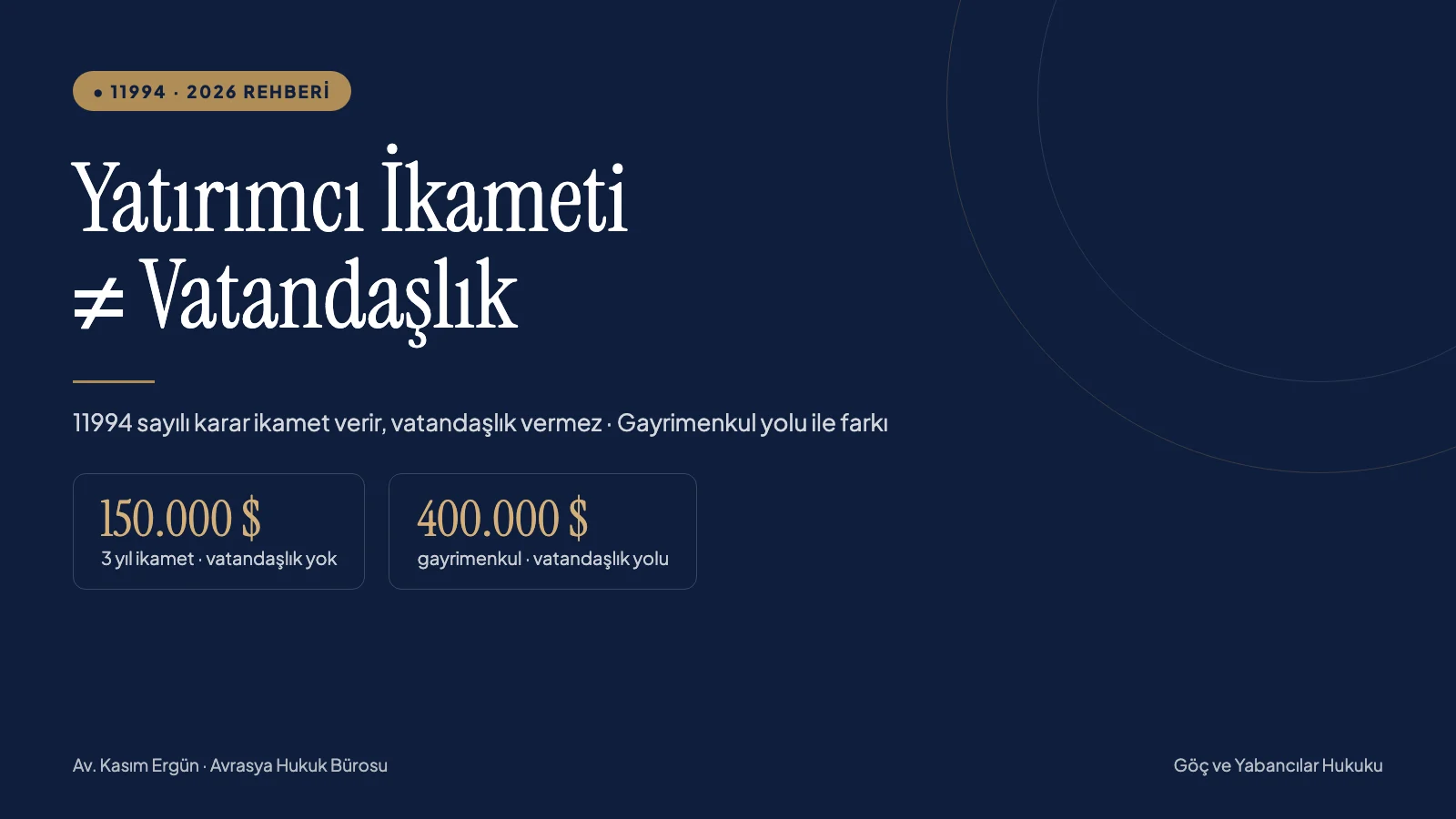
In brief: Presidential Decision No. 11994, published in the Official Gazette of 18 November 2026 (No. 33434), provides for a residence permit of 3 years for a USD 150,000 investment, or 5 years for USD 200,000, for a foreign investor who does not work in Turkey. The permit is not Turkish citizenship. Article 4 of the Decision states that residence permits issued under it are not to be assessed under Article 12 of Law No. 5901 on Turkish Citizenship. Exceptional citizenship through real estate is a separate regime. Its threshold is USD 400,000 and a three-year non-sale annotation on the land registry.
The claim that "citizenship is now available for USD 150,000" has circulated since the Decision was published. It is not correct. The new Decision is a residence-permit regime. It does not lower the price of citizenship. Distinguishing the two doors before you invest can prevent the loss of both time and money that may be hard to recover. For the conditions of the new permit, see our article on Decision 11994. For an overview of residence types and routes to citizenship, see Residence Permits and Routes to Citizenship in 2026. This article deals only with the difference.
Two Separate Regimes: Residence and Citizenship
A residence permit is the right to stay in Turkey for a stated period and purpose. Decision 11994 rests on Article 31(1)(j) and Article 31(5) of Law No. 6458 on Foreigners and International Protection (LFIP): a foreigner who does not work in Turkey but will invest in the scope and amount set by the President, together with that person's foreign spouse and the minor or dependent foreign child of either spouse, may be granted a short-term residence permit for up to five years (LFIP Art. 31(1)(j), Art. 31(5)). The list annexed to the Decision provides for 3 years for USD 150,000 or the equivalent in foreign currency, and 5 years for USD 200,000 or the equivalent. The investment may be a bank deposit in Turkey, government debt instruments, units in a real-estate or venture-capital investment fund, or a contribution to the private pension system, and it must be held for half the term of the permit (Decision Art. 2).
Citizenship is a different status: a Turkish identity, a passport and the rights that follow. Exceptional citizenship may be granted by presidential decision under Article 12 of Law No. 5901. Article 12(1)(b) links that route to persons who hold a residence permit under LFIP Article 31(1)(j), to Turquoise Card holders, and to certain family members. The investment thresholds are not set out as figures in the Law; they appear in Article 20(2) of the Regulation on the Implementation of the Turkish Citizenship Law.
This is why Article 4 of Decision 11994 matters. It severs that link for permits issued under this Decision: they are not to be assessed under Article 12 of Law No. 5901. Article 12(1)(b) of the Law remains in force, and the USD 400,000 and USD 500,000 exceptional-investment routes remain. What has changed is that the new residence permit obtained for USD 150,000 or USD 200,000 cannot be used as a basis for exceptional citizenship.
How Decision 11994 Differs from Citizenship by Property
Exceptional citizenship through real estate rests on Article 20(2)(b) of the Regulation. The foreigner must purchase, with a three-year non-sale annotation on the land registry, a property with condominium or construction servitude, or a plot registered as land with a building on it, worth at least USD 400,000 or the equivalent in foreign currency. Alternatively, the same amount may be paid in advance under a notarised promise of sale for a property with condominium or construction servitude, with an annotation that no transfer or cancellation will be made for three years. The Ministry of Environment, Urbanisation and Climate Change records the investment. The amount was raised from USD 250,000 to USD 400,000 by Presidential Decision No. 5554, published in the Official Gazette of 13 May 2022 (No. 31834). The amendment of 12 December 2023 narrowed the type of property; it did not change the amount. As of 20 November 2026, no later Official Gazette instrument changing that amount has been identified. The thresholds may be changed again by presidential decision, so the current text should be checked before any investment.
Other subparagraphs of the same article set a threshold of USD 500,000, generally to be held for three years, for fixed capital, bank deposits, government debt instruments, fund units and the private pension system (Regulation Art. 20(2)(a), (ç)–(f)). Some of those instruments resemble the tools in Decision 11994. The amount, the holding period and the legal result are different.
| Decision 11994 investor residence | Exceptional citizenship by property | Exceptional citizenship by financial investment | |
|---|---|---|---|
| Legal basis | Decision 11994; LFIP Art. 31(1)(j), 31(5) | Law No. 5901 Art. 12; Regulation Art. 20(2)(b) | Law No. 5901 Art. 12; Regulation Art. 20(2)(a), (ç)–(f) |
| Result | A 3- or 5-year residence permit | Citizenship by presidential decision (conditions + discretion) | Citizenship by presidential decision (conditions + discretion) |
| Minimum amount | USD 150,000 or 200,000 | USD 400,000 | USD 500,000 |
| Investment | Deposit, government debt, real-estate or venture-capital fund units, private pension | Condominium / construction servitude or land with a building; or a notarised promise of sale | Fixed capital, deposit, government debt, fund units, private pension |
| Holding period | Half the term of the permit | A 3-year non-sale annotation | As a rule, 3 years |
| Direct purchase of a home | Not on the list | The principal route | No |
| Law No. 5901 Art. 12 | Excluded by Decision Art. 4 | This is the field of that article | This is the field of that article |
The list annexed to Decision 11994 does not include the direct purchase of a home or workplace. Buying a home does not, on the strength of this Decision, confer the new investor residence permit. A separate short-term residence route exists for foreigners who own immovable property in Turkey (LFIP Art. 31(1)(b)); the nature and value of that property are determined by the Ministry (LFIP Art. 31(6)). That route is not citizenship either. For the practical setting of property purchase, see Real Estate Acquisition for Foreigners.
Common Misconceptions
Misconception: "USD 150,000 is now a right to citizenship."
No. USD 150,000 is the minimum for a 3-year investor residence permit. USD 200,000 is the minimum for a 5-year permit. Neither creates a right to apply for Turkish citizenship. Article 4 of the Decision puts the point beyond interpretation: permits issued under the Decision are not assessed under Article 12 of Law No. 5901.
Misconception: "If I buy a home under this Decision, I obtain both residence and citizenship."
No. Decision 11994 does not treat the purchase of a home as an eligible investment. The text does not support obtaining both this new residence permit and citizenship by buying a home. Citizenship through property is a separate route, and its threshold is USD 400,000, together with the three-year annotation, the nature of the property and the Ministry's determination. A cheaper home falls neither under Decision 11994 nor under Article 20(2)(b) of the Regulation.
Misconception: "This permit replaces a work permit."
No. The Decision is aimed at an investor who does not work in Turkey (Art. 1). It is not a work permit and does not replace one. A foreigner who wishes to work in Turkey must obtain a work permit as well. Confusing residence with the right to work may lead to administrative sanctions and may put the residence permit itself at risk.
Misconception: "The 3- or 5-year permit automatically counts towards ordinary naturalisation or long-term residence."
Article 4 of the Decision excludes only Article 12 of Law No. 5901. The five years of continuous residence required for ordinary naturalisation (Law No. 5901 Art. 11) and the period required for a long-term residence permit (LFIP Art. 42) are not dealt with in the Decision. LFIP Article 28(2) counts half of student permits and the whole of other residence permits towards continuous residence. How that rule will apply to permits under Decision 11994 depends on the Interior Ministry's procedures, which as of 20 November 2026 have not been published. We do not say that the period automatically counts towards ordinary naturalisation or long-term residence; nor do we read the Decision as saying that it does not.
The Application Procedure Has Not Yet Been Published
Article 3 of the Decision leaves the procedures and principles for services and other transactions concerning foreigners in this category to the Ministry of Interior. The Decision entered into force on publication, on 18 November 2026 (Art. 5). Even so, as of 20 November 2026 no Decision-specific rules on the place of application, the documents or the e-Ikamet process appear to have been published. This section should be updated when the Ministry of Interior or the Directorate of Migration Management issues a notice. Investing before the procedure is clear risks locking in funds while a permit cannot yet be issued.
Frequently Asked Questions
Can I become a Turkish citizen with USD 150,000?
No. That amount is the minimum for a 3-year residence permit under Decision 11994. Under Article 4, the permit is not assessed under Article 12 of Law No. 5901.
Does a 5-year permit for USD 200,000 confer citizenship?
No. The longer term does not change the legal result. It remains a residence permit and does not create a right to exceptional citizenship.
Can I rely on Decision 11994 by buying a home?
The annexed list does not include the direct purchase of immovable property. Buying a home is not one of the investment tools for this investor residence permit. Short-term residence for property owners (LFIP Art. 31(1)(b)) and the USD 400,000 citizenship route are separate regimes.
How much is required for citizenship by investment?
Under Article 20(2) of the Regulation, at least USD 400,000 (or the equivalent in foreign currency) is required for property, and at least USD 500,000 for the financial and fixed-capital routes. The holding period and the authority that records the investment vary. Meeting the conditions does not give an absolute right to citizenship (Law No. 5901 Art. 10(1)).
May I work in Turkey with this permit?
No. The Decision is for an investor who does not work. A separate work permit is required in order to work.
Does time on this permit count towards the five-year ordinary naturalisation route?
The Decision does not answer that question. Article 4 excludes only exceptional citizenship (Law No. 5901 Art. 12). Until the Interior Ministry's procedures are published, no firm promise can be made about ordinary naturalisation (Art. 11) or long-term residence.
Are my spouse and children covered?
Article 1 of the Decision covers the investor's foreign spouse and the minor or dependent foreign child of the investor or of the spouse. That does not confer citizenship on the family. Article 4 of the same Decision takes these permits outside Article 12 of Law No. 5901.
Conclusion
Decision 11994 opens a new residence route for a foreign investor who does not work in Turkey. It does not open a route to citizenship. USD 150,000 or USD 200,000 is for residence. Exceptional citizenship through property is a separate path, and its threshold is USD 400,000. Article 4 of the Decision writes that distinction into the text. Choosing the correct route before you invest helps avoid the loss of money and time spent on a promise the Decision does not make. What happens to a family residence permit and to citizenship by marriage on divorce is a separate question; see Residence After Divorce from a Turkish Spouse (2026).
If you need assistance in choosing between investor residence and the citizenship routes, Avrasya Hukuk Bürosu advises clients in Bakırköy on immigration and foreigners law. You may request an initial consultation or read our Immigration and Foreigners Law page. Legislation and practice may change. This article is for general information and is not legal advice.
Primary sources: Presidential Decision No. 11994 (Official Gazette 18 November 2026/33434) · Law No. 6458 · Law No. 5901 · Regulation on the Implementation of the Turkish Citizenship Law