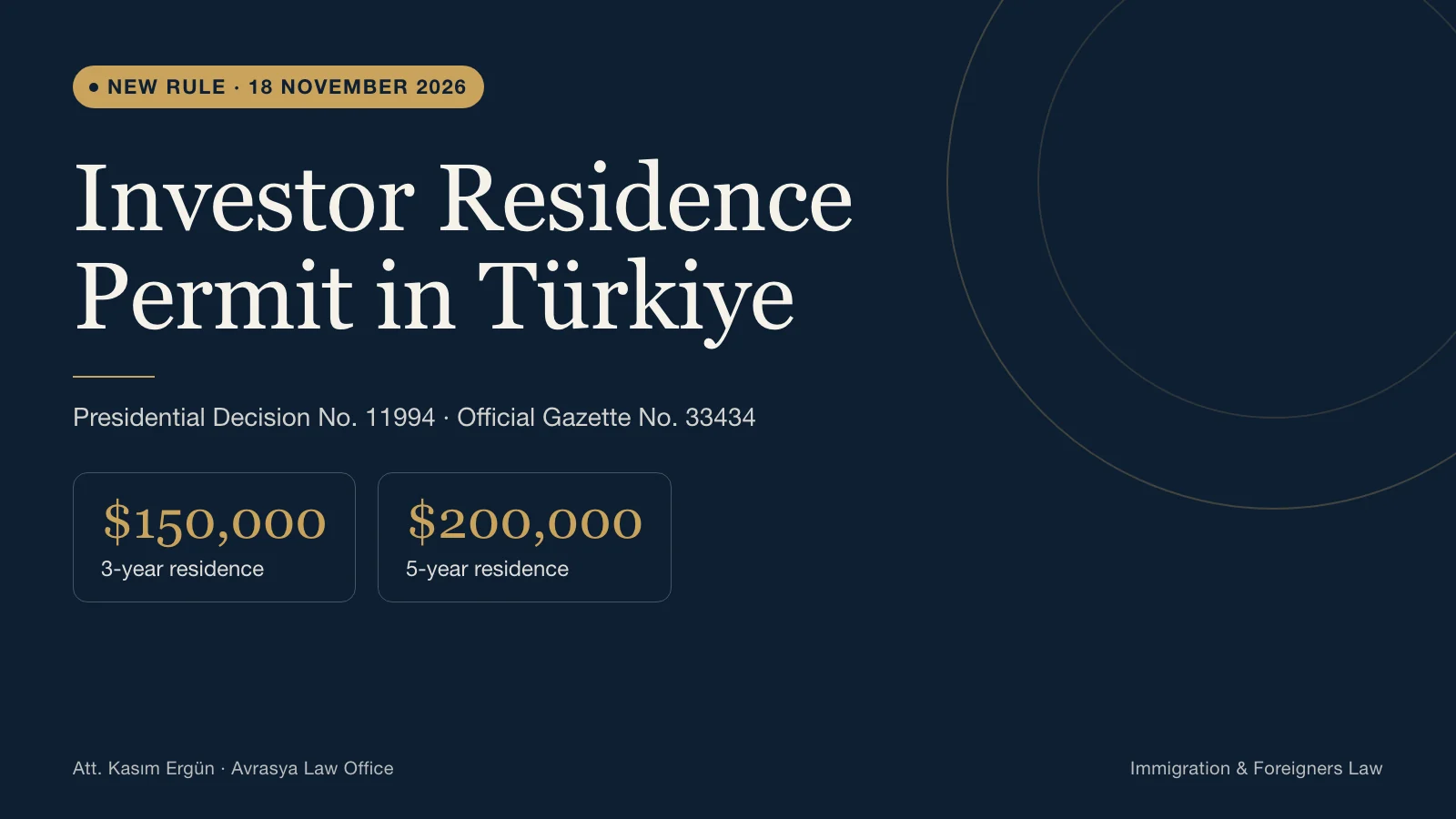
New rule · 18 November 2026: Presidential Decision No. 11994 was published in the Official Gazette of 18 November 2026, No. 33434, and entered into force the same day. Full text (Turkish): Official Gazette, 18.11.2026, No. 33434. We will update this guide once the Ministry of Interior publishes the implementing rules.
Short answer: Under the "Decision on Residence Permits to Be Issued to Foreign Investors", put into force by Presidential Decision No. 11994 and published in the Official Gazette No. 33434 on 18 November 2026, a foreign national who does not work in Türkiye but invests at least USD 150,000 may receive a 3-year residence permit, and one who invests at least USD 200,000 may receive a 5-year permit. The investment can be made through a bank deposit, government debt securities, units of a real estate or venture capital investment fund, or the private pension system, and must be held for half of the permit term. The investor's foreign spouse and children are also covered. This permit is not a route to citizenship; the Decision entered into force on the date of publication.
At a Glance: Decision No. 11994
Investor residence permit in Türkiye: key facts
| Regulation | Decision on Residence Permits to Be Issued to Foreign Investors (Decision No. 11994) |
|---|---|
| Publication and entry into force | Official Gazette 18.11.2026, No. 33434; in force from publication (Art. 5) |
| Legal basis | Law No. 6458 on Foreigners and International Protection (LFIP), Art. 31(1)(j) and 31(5) |
| Amount and duration | At least USD 150,000: 3 years · At least USD 200,000: 5 years (or the equivalent in foreign currency) |
| Qualifying investments | Bank deposit, government debt securities, real estate or venture capital investment fund units, private pension contributions (Art. 2) |
| Holding period | Half of the permit term: 1.5 years for a 3-year permit, 2.5 years for a 5-year permit |
| Family | Foreign spouse and the minor or dependent foreign children of the investor and the spouse (Art. 1) |
| Right to work | None; the permit is for investors who do not work in Türkiye |
| Citizenship | Does not lead to citizenship by exception (Art. 4) |
| Procedure | To be set by the Ministry of Interior (Art. 3) |
"I want to live in Türkiye but I won't work. Can I get a residence permit without buying a home?" "Has the citizenship investment amount been lowered?" "I was deported before. If I invest this money, can I come back?" These were the most common questions on social media the night the Decision was published, and many of them were answered incorrectly. This guide explains what the new Decision introduces, where it fits in the existing residence system, how it differs from citizenship, and, above all, the practical pitfalls to know before applying.
Has the Regulation Really Been Published?
Yes. Presidential Decision No. 11994, published in the Official Gazette of 18 November 2026, No. 33434, was signed on 17 November 2026 and put into force under Article 31 of Law No. 6458 on Foreigners and International Protection (LFIP). Two common misconceptions need correcting. First, the investment amount required for citizenship has not been lowered; the Decision concerns residence permits only. Second, saying that "the conditions were reorganised" is not quite accurate: investor residence has existed in the Law since 2016, but this is the first stand-alone decision setting the scope and amount of this provision for residence purposes only.
Legal Basis: LFIP Article 31(1)(j) and 31(5)
LFIP Article 31(1)(j) was added in 2016 by Law No. 6735 and allows a short-term residence permit to be granted to "those who do not work in Türkiye but will make an investment within the scope and amount determined by the President, and to their foreign spouse and their and their spouse's minor or dependent foreign children". A short-term residence permit is, as a rule, granted for a maximum of two years at a time (Art. 31(2)); paragraph (j), together with paragraph (k) on citizens of the TRNC, is an exception to this rule, and permits under these paragraphs may be granted for periods of up to five years each (Art. 31(5)).
The new permit is therefore not a separate type of residence permit but a special sub-category of the short-term residence permit. The general conditions for short-term residence (Art. 32) and the grounds for refusal, cancellation and non-renewal (Art. 33) also apply to these permits.
What the Decision Introduces
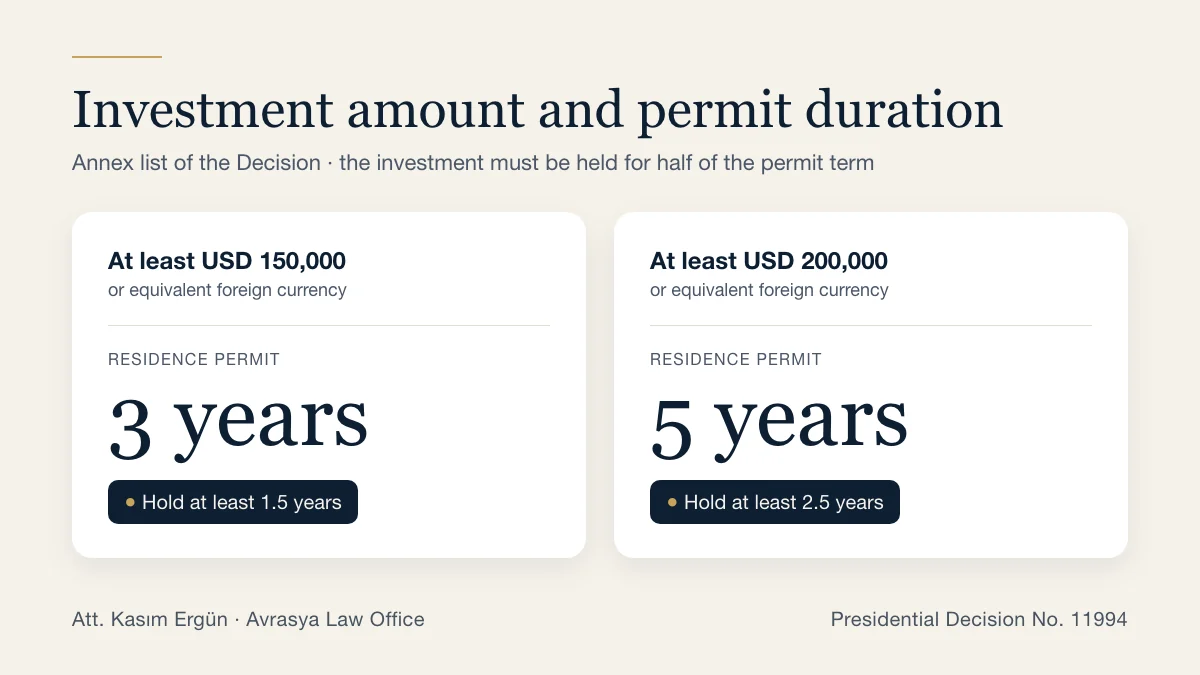
1. Amount and duration (annex list)
- At least USD 150,000 or the equivalent in foreign currency: 3-year residence permit
- At least USD 200,000 or the equivalent in foreign currency: 5-year residence permit
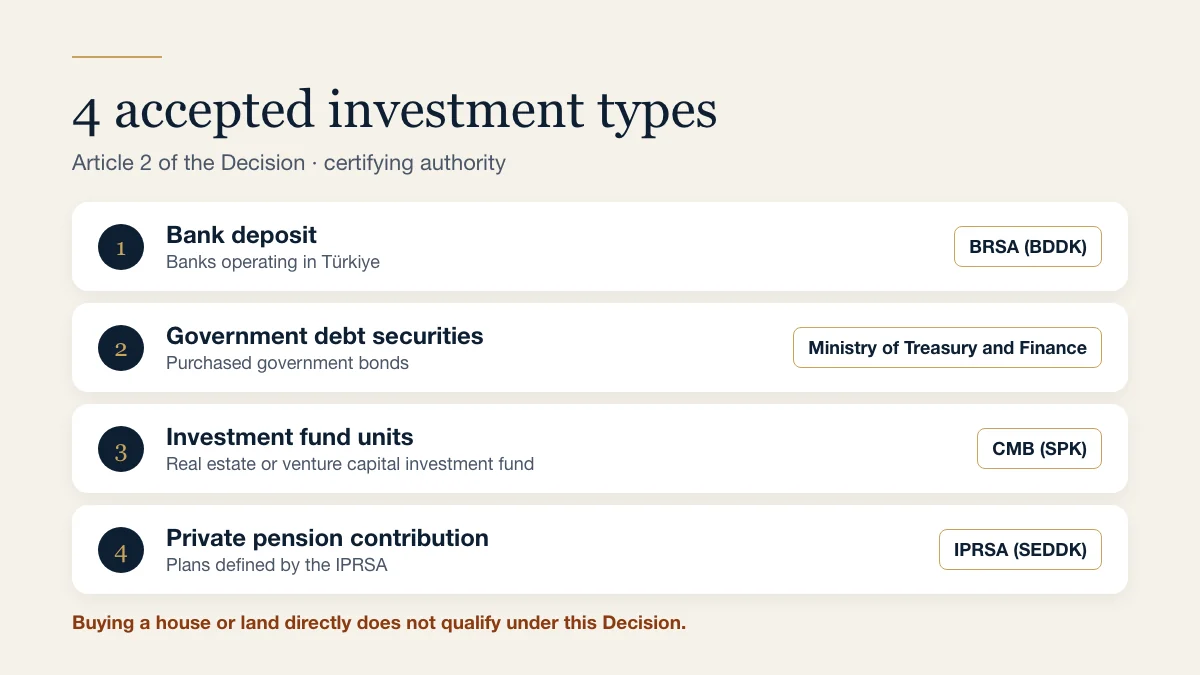
2. Qualifying investments and certifying authority (Art. 2)
- Deposit with banks operating in Türkiye: Banking Regulation and Supervision Agency (BRSA / BDDK)
- Government debt securities: Ministry of Treasury and Finance
- Units of a real estate investment fund or venture capital investment fund: Capital Markets Board (CMB / SPK)
- Private pension contributions in plans defined by the Insurance and Private Pension Regulation and Supervision Agency (IPRSA / SEDDK): IPRSA
The common condition for every option is that the investment must be held for half of the permit term: at least 1.5 years for a 3-year permit and at least 2.5 years for a 5-year permit.
3. Family members, procedure and entry into force (Arts. 1, 3, 5, 6)
The investor's foreign spouse and the minor or dependent foreign children of the investor and the spouse are also covered. The procedures for applications, documents and other steps will be set by the Ministry of Interior; the Presidency of Migration Management has not yet announced implementation details.
Relationship with Citizenship: Why Article 4?
Article 12(1)(b) of Turkish Citizenship Law No. 5901 lists, among those who may acquire citizenship by exception, "those who obtain a residence permit under paragraph (j) of the first paragraph of Article 31 of Law No. 6458". Until now, paragraph (j) served as the residence leg of citizenship-by-investment. Without Article 4 of the Decision, which provides that "residence permits issued under this Decision shall not be assessed within the scope of Article 12 of Law No. 5901", it could have been argued that anyone obtaining a paragraph (j) permit with USD 150,000 could apply for citizenship based on the wording of the law.
It is therefore now possible to speak of two separate regimes under the same paragraph: a paragraph (j) permit based on the investment thresholds in citizenship legislation, and a paragraph (j) permit based on Decision No. 11994 that provides residence only. The amount and conditions for citizenship-by-investment are separate and stricter. See our Turkish citizenship application page for details.
Does the time count towards ordinary naturalisation?
Article 4 of the Decision excludes only citizenship by exception (Art. 12); it does not prohibit ordinary naturalisation (Law No. 5901, Art. 11). The Regulation on the Implementation of the Turkish Citizenship Law does not count residence for tourism, education, medical treatment, accompanying a child in education, or asylum towards the five-year period (Arts. 16(2)(c), 71(1)(ç)); even if a tourist permit is later converted into a qualifying permit, the earlier period is not counted (Art. 71(1)(d)). Since investor residence is not on this list, we are of the opinion that, for an investor actually living in Türkiye, this period may be considered valid residence for ordinary naturalisation. However, spending a total of more than six months abroad during the period interrupts the residence period (Art. 71(1)(b), (c)), and other conditions such as Turkish language, means of subsistence and intention to settle also apply. A 5-year permit in particular makes this period easier to plan by removing the risk of interim renewals.
Impact on the Existing Residence System
Difference from residence through property
The short-term residence permit for foreigners who own residential property (Art. 31(1)(b)) continues unchanged; the qualifications and value of the property are set by the Ministry (Art. 31(6)), and the permit is granted for a maximum of two years at a time. The new Decision, by contrast, does not include direct property purchases; in the real estate field, only units of a real estate investment fund qualify. For residence through home ownership, see our property purchase for foreigners guide.
The "non-working" investor condition and company shareholding
This permit does not grant the right to work; unauthorised work can lead to cancellation on the ground that the permit is being used for a purpose other than the one it was issued for (LFIP Art. 33(1)(b)). For company shareholding, the distinction is as follows: under Article 10(5) of International Labour Force Law No. 6735, a managing director who is a shareholder of a limited company and a board member who is a shareholder of a joint-stock company may work only with a work permit; for these persons the right route is a work permit, not investor residence (a work permit already counts as a residence permit, LFIP Art. 27, ILFL Art. 12(1)). By contrast, shareholding that only contributes capital without a management role is, as a rule, not considered "work". Board members of joint-stock companies who do not reside in Türkiye and non-managing shareholders of other companies are subject to the work permit exemption regime and must obtain an exemption if they will carry out activities (ILFL Arts. 13(1), 13(7)). Note also that periods spent under an exemption are not counted towards residence periods (ILFL Art. 13(6)).
Current permit holders and long-term residence
A foreign national holding a tourist, property or family residence permit may request a transfer to a permit matching the new purpose once the conditions are met (LFIP Arts. 29, 22(1)(ğ)). All time spent on short-term permits is counted towards uninterrupted residence (Art. 28(2)); the investor permit therefore contributes to the 8 years required for long-term residence. However, stays abroad exceeding a total of six months in a year, or a total of one year in the last five years, count as an interruption (Art. 28(1)).
Practical Pitfalls to Know Before Applying
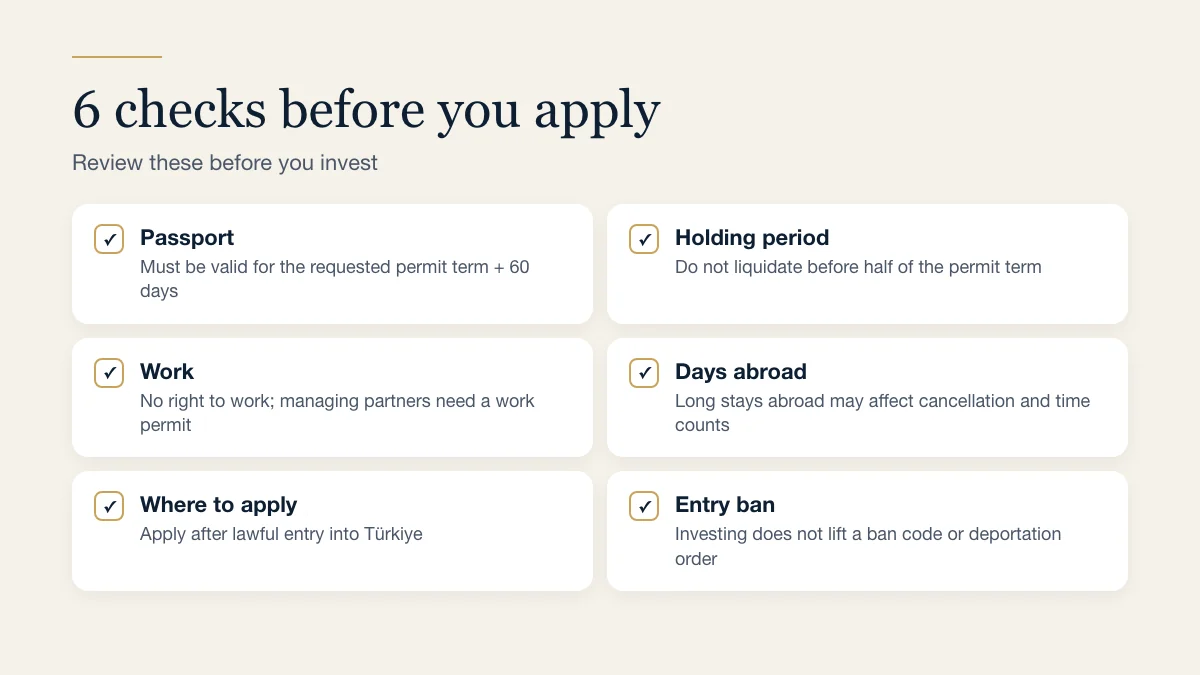
1. Passport validity: 5 years + 60 days
Under LFIP Article 21(2), the applicant must hold a passport valid for sixty days longer than the requested residence period; the residence permit is also issued sixty days shorter than the passport's validity (Art. 23(1)). An investor whose passport expires in three years will receive a permit shortened to match the passport, not a 5-year permit, even after investing USD 200,000. The passport should be renewed before investing.
2. Early liquidation and renewal
Liquidating the investment before half of the permit term means the condition on which the permit is based no longer exists, and the permit may be cancelled (LFIP Art. 33(1)(a)). Under the wording of the Decision, withdrawing the investment after the minimum holding period should not, on its own, be a ground for cancellation for the remaining term. However, the purpose of stay will need to be documented again in a renewal application at the end of the term.
3. Time spent abroad
The cancellation ground in the original text of the Law (Art. 33(1)(c)), "staying abroad for more than 120 days in the last year", was repealed by Law No. 6735 and replaced by a provision stating that the procedures for cancellation due to stays abroad will be set by regulation (Art. 33(2)). Nevertheless, the 120-day rule in Article 29(1)(c) of the Implementing Regulation still appears in consolidated texts, and a regulatory provision does not lapse automatically unless repealed. It is therefore prudent for investors to track their days abroad. Apart from the cancellation risk, long stays abroad interrupt the periods for long-term residence (Art. 28) and citizenship (Citizenship Regulation, Art. 71).
4. Foreign currency requirement
The list uses the wording "US dollars or the equivalent in foreign currency"; unlike citizenship legislation, Turkish lira is not mentioned. Since a significant share of government debt securities, funds and private pension plans are denominated in Turkish lira, how a conversion of foreign currency into these instruments will be shown in the certification letters will become clear with the implementing rules.
5. Applications are made from within Türkiye
According to statements by the Presidency of Migration Management, residence permit applications are not yet accepted from abroad; the foreign national must apply after lawfully entering Türkiye under the visa regime. Even if the investment can be made through a power of attorney, a foreign national with an entry ban will be stopped at this stage.
Can Deported Foreigners or Those with a Ban Code Benefit?
Short answer: An investment does not automatically lift an entry ban. A short-term residence permit is not granted to a foreign national subject to a valid deportation or entry ban decision (LFIP Art. 33(1)(ç)); persons banned from entry are not granted visas (Art. 15(1)(b)) and are refused at the border (Art. 7(1)(c)).
- Entry bans arising from overstays: An entry ban may not be imposed on a foreign national who overstayed a visa or permit, left voluntarily, paid the fine and did not exceed the overstay periods set by the Ministry (Art. 9(4)). If a ban has been imposed, the Presidency of Migration Management may lift it or allow entry for a certain period while keeping the ban in place (Art. 9(6)). However, temporary entry permission is not enough to obtain a residence permit; the ban must be lifted or annulled by a court.
- Public order and security codes: The application of a foreign national considered a risk to public order or public security will be refused even with a BRSA certification letter (Arts. 15(1)(c), 33(1)(ç)). In these files, the basis of the code must first be identified and, if necessary, an annulment action filed.
- Persons overstaying in Türkiye: A foreign national whose stay has expired may apply from within Türkiye only under the exceptions in the Law (Art. 22); for an investor permit, the situation must, as a rule, first be regularised.
- Persons under international or temporary protection: These statuses are subject to a separate regime; transferring to this permit while the status continues does not generally appear possible.
The rule is simple: a foreign national with a past deportation or entry ban record should have their record reviewed by a lawyer before investing and blocking the funds. Otherwise, the application may be refused while the investment remains blocked. See our appeal against deportation guide, and our article What Is a Restriction Code? for what entry ban codes mean and how to apply from abroad.
Rights in Case of Refusal or Cancellation
An annulment action may be filed before the administrative court within 60 days of notification of the refusal or cancellation (Administrative Procedure Law No. 2577, Art. 7). Under LFIP Article 31(7), in actions against refusal or cancellation of short-term residence, the file is deemed complete once the defence is submitted or the defence period expires, and a hearing is at the court's discretion; petitions and evidence should therefore be submitted in full at the first stage. A cancelled residence permit is a ground for deportation (Art. 54(1)(f)); a foreign national whose renewal application is refused must leave within ten days (Art. 54(1)(j)). We explain the steps to take after a refusal in our article What to Do If a Residence Permit Is Refused.
Frequently Asked Questions
When did the investor residence permit decision enter into force?
Presidential Decision No. 11994 was signed on 17 November 2026, published in the Official Gazette of 18 November 2026, No. 33434, and entered into force on the date of publication. The application procedure will be set by the Ministry of Interior.
Do I have to buy a home to get an investor residence permit in Türkiye?
No. The Decision does not include direct property purchases; you can invest through a bank deposit, government debt securities, investment fund units or the private pension system.
How long must I keep the money invested?
For half of the permit term: at least 1.5 years for a 3-year permit and at least 2.5 years for a 5-year permit.
Can my spouse and children also benefit from this permit?
Yes. The investor's foreign spouse and the minor or dependent foreign children of the investor and the spouse are covered by the Decision.
Can I work in Türkiye with this permit?
No. The permit is granted to investors who do not work in Türkiye; unauthorised work can lead to cancellation. If you will work, you need a work permit.
Can I become a Turkish citizen with this permit?
Not through citizenship by exception (citizenship by investment) (Art. 4 of the Decision). If you actually live in Türkiye without interruption, the time spent on this permit may be considered for ordinary naturalisation.
Can I get this permit if I set up a company?
Contributing capital as a non-managing shareholder is not an obstacle on its own. However, if you will work as the managing director of a limited company or as a board member of a joint-stock company, you need a work permit.
Does my passport validity matter?
Yes. For a 5-year permit, your passport must be valid for at least 5 years and 60 days; otherwise, the permit will be issued for a shorter period.
I was deported. Can I return if I invest?
An investment does not lift an entry ban. The type and duration of the ban must first be reviewed, and the ban must be lifted or annulled.
Conclusion
Decision No. 11994 turns investor residence, which has been in the Law for nearly ten years, into an option independent of citizenship and tied to specific amounts. The regulation matters for foreign nationals seeking a long-term, predictable status in Türkiye with their families. However, this is a short-term residence permit: liquidating the investment early, unauthorised work, a short passport validity and past entry ban records can put the investment at risk. We will update this guide once the Ministry of Interior publishes the implementing rules.
Need support with planning an investor residence permit, reviewing an entry ban record, or challenging a refusal or cancellation in court? Euroasia Law Office serves clients in immigration and foreigners law from Bakırköy, Istanbul. Request an initial consultation or visit our Immigration and Foreigners Law page.
Sources
- Presidential Decision No. 11994, Official Gazette 18.11.2026, No. 33434 (Turkish)
- Law No. 6458 on Foreigners and International Protection (Turkish)
- Turkish Citizenship Law No. 5901 (Turkish)
- International Labour Force Law No. 6735 (Turkish)
- Regulation on the Implementation of the Turkish Citizenship Law; Regulation on the Implementation of the Law on Foreigners and International Protection
As legislation and practice may change, this content is for general information only and does not constitute legal advice. Published: 18 November 2026 · Last updated: 18 November 2026 · Author: Kasım Ergün