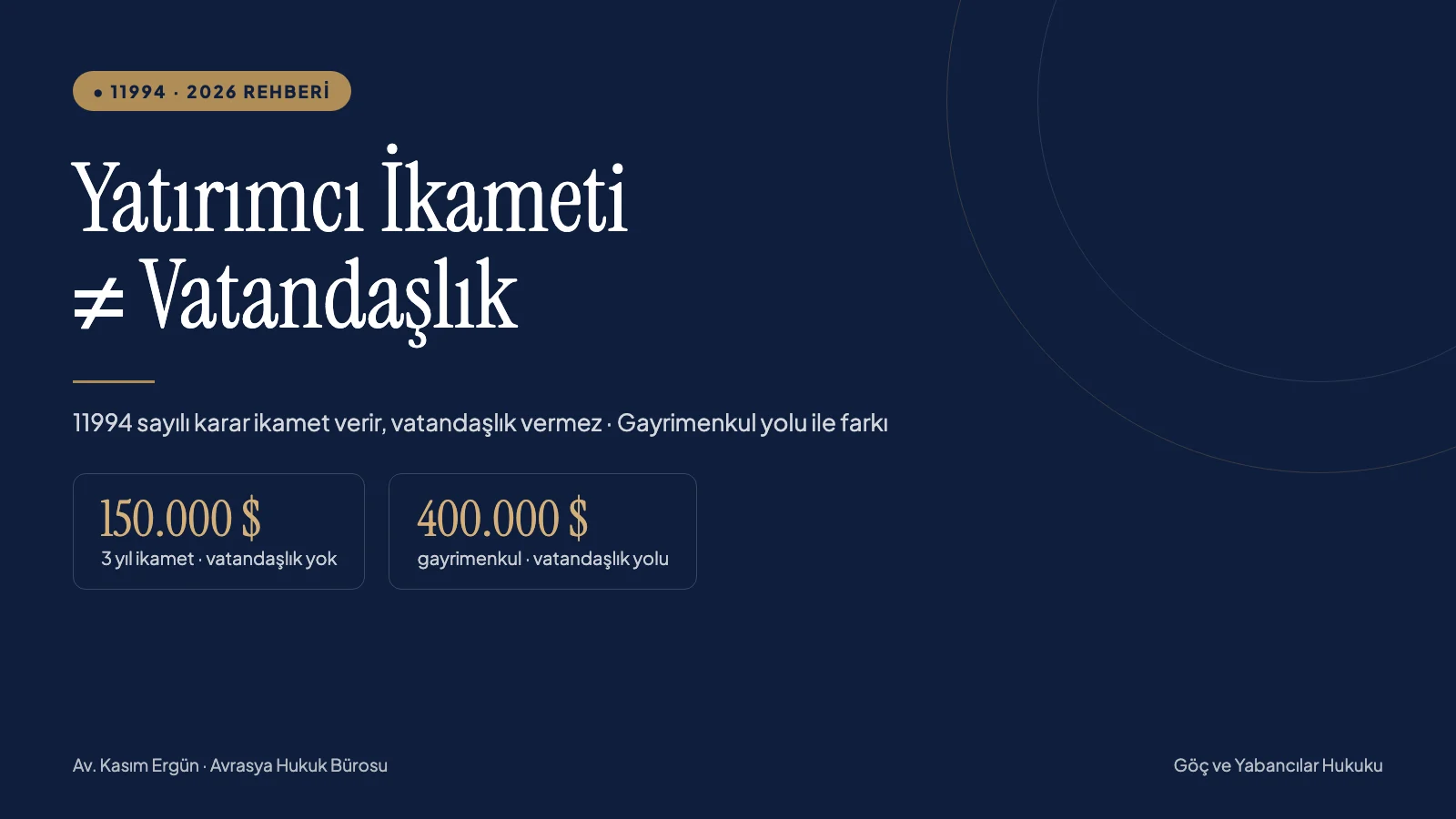
In short: Turkish law provides six types of residence permit: short-term, family, student, long-term, humanitarian and trafficking-victim permits (Law No. 6458 on Foreigners and International Protection, "LFIP", Art. 30). A residence permit does not, on its own, give the right to work; employment requires a work permit or a Turquoise Card. Turkish citizenship is acquired by descent or birth, by marriage of at least three years, by five years' residence (general naturalisation), or by Presidential decision on exceptional grounds, including investment. The key distinction: USD 150,000-200,000 buys residence; citizenship by investment starts at USD 400,000-500,000. They are two separate systems. Presidential Decision No. 11994, in force since 18 November 2026, grants a residence permit only, not citizenship.
"Can I now get a Turkish passport for USD 150,000?" "If I buy a flat, do I automatically get residence?" "Does marrying a Turkish citizen make me a citizen straight away?" Since the new investor residence decision was published, we have been hearing these questions every day, and much of what circulates online is wrong. This article gives a high-level map of the statuses under which foreign nationals can live in Turkey and the routes to citizenship, focusing on the misconceptions that most often cost people money, time and legal rights.
Types of Residence Permit in Turkey (2026)
A foreign national who intends to stay longer than their visa or visa exemption allows, or longer than 90 days, must obtain a residence permit (LFIP Art. 19). The law recognises six types (Art. 30). Each permit is tied to a specific purpose of stay; if that purpose ends, the permit is at risk. A valid work permit or work permit exemption also counts as a residence permit (LFIP Art. 27; Law No. 6735, Art. 12).
1. Short-term residence permit (LFIP Arts. 31-33)
A short-term residence permit is granted for purposes listed in the law, such as tourism, property ownership, business connections, medical treatment or Turkish language courses, and is issued for up to two years at a time as a rule (Art. 31(2)). Applications are filed through the e-İkamet system; the core requirements are a valid passport, health insurance, sufficient means and a registered address (Art. 32).
Residence through property ownership: The law leaves it to the Ministry of Interior to set the type and value of qualifying property (Art. 31(6)); the USD 200,000 figure comes from administrative practice, not from the statute. According to the e-İkamet document list of the Presidency of Migration Management, for homes acquired on or after 16 October 2023 a single dwelling must be worth at least the equivalent of USD 200,000 and must actually be used as the applicant's home.
Closed neighbourhoods: In 2022, neighbourhoods where foreign residents exceeded 20% of the population were closed to new foreign address registrations, and the number rose to 1,169 (official announcement). Many neighbourhoods are reported to have reopened in practice in 2026, but no official announcement has been published. Always check that the address is eligible before signing a lease or buying.
New: residence through investment (Decision No. 11994): Presidential Decision No. 11994, published in Official Gazette No. 33434 of 18 November 2026, provides for a 3-year residence permit for a foreign national who does not work in Turkey and invests at least USD 150,000 or the equivalent in foreign currency, and a 5-year permit for at least USD 200,000. The Decision is based on LFIP Art. 31(1)(j) and Art. 31(5) (Decision Art. 1).
- Eligible investments: deposits with banks operating in Turkey, government debt securities, units in real estate or venture capital investment funds, and the private pension system (Decision Art. 2). A direct home purchase is not on the list.
- Holding period: the investment must be held for half of the permit period.
- Family: the foreign spouse and minor or dependent children are covered.
- Citizenship: these permits are not assessed under Article 12 of Law No. 5901 (exceptional citizenship) (Decision Art. 4).
- Procedure: the Ministry of Interior will set the application rules (Decision Art. 3); as of 19 November 2026 they have not been published.
Note on Art. 31(1)(j) and citizenship: Article 12(1)(b) of the Turkish Citizenship Law lists persons holding a residence permit under LFIP Art. 31(1)(j) among those eligible for exceptional citizenship. The new Decision relies on the same provision, but its Article 4 expressly cuts that link for the USD 150,000-200,000 permits. In effect, the same provision now covers two tracks: the investor permit tied to the citizenship thresholds, and the residence-only permit under Decision No. 11994. See our Investor Residence Permit guide.
Must the money come from abroad? The text of Decision No. 11994 contains no express requirement that the funds come from abroad or from a foreign account. It requires the amount to be invested in US dollars or the equivalent in foreign currency and certified by the competent authority (BRSA, Ministry of Treasury and Finance, CMB or IPRSA); it does not provide for a Turkish lira amount. How the source of funds must be documented will become clear once the Ministry issues its implementing rules. The rules for citizenship by investment are stricter: before the transaction, the foreign currency is sold to a bank in Turkey and through it to the Central Bank, and the bank issues a Foreign Exchange Purchase Certificate (DAB) (Citizenship Regulation Art. 20(10); CBRT implementing instruction). Since 24 January 2022, foreign individuals buying property must also present a DAB at the land registry (Land Registry announcement). In every case, banks check the source of funds under anti-money-laundering rules, so it pays to plan the transfer before sending any money.
2. Family residence permit (LFIP Arts. 34-37)
A family residence permit is granted to the foreign spouse and the minor or dependent foreign children of a Turkish citizen, a Blue Card holder or a foreign national residing in Turkey, for up to three years at a time. It never runs beyond the sponsor's own permit, and the sponsor must meet income, accommodation and health insurance requirements. If a marriage of convenience is established, the permit is cancelled (Art. 37).
3. Student residence permit (LFIP Arts. 38-41)
A student residence permit is granted to those enrolled in associate, bachelor's, master's or doctoral programmes in Turkey. Students may work only with a work permit; for associate and bachelor's students this becomes possible after the first year of study (Art. 41).
4. Long-term residence permit (LFIP Arts. 42-45)
A long-term residence permit is an indefinite permit for foreign nationals who have lived in Turkey on residence permits for at least eight uninterrupted years. Besides the eight years, applicants must not have received social assistance in the last three years, must have sufficient and regular income and valid health insurance, and must pose no public order risk (Art. 43). Holders enjoy many of the rights granted to Turkish citizens, subject to the exceptions in Art. 44 (military service, voting and standing for election, entering public service, duty-free vehicle import) and to special legislation. The right to work is not automatic: a long-term resident may apply for an indefinite work permit, but meeting the criteria does not create an absolute right (Law No. 6735, Art. 10(3)). Humanitarian permit holders and persons under international or temporary protection cannot transfer to this permit (Art. 42(2)).
5. Humanitarian residence permit (LFIP Arts. 46-47)
A humanitarian residence permit is granted, without the usual requirements, for periods set by the Ministry in situations such as the best interests of a child, foreigners who cannot be removed, or extraordinary circumstances.
6. Residence permit for victims of human trafficking (LFIP Arts. 48-49)
This permit is first issued for a 30-day recovery and reflection period and may be extended in six-month increments, but the total may not exceed three years.
Work permits and the Turquoise Card
Working in Turkey requires a work permit or a work permit exemption under the International Labour Force Law No. 6735 (Art. 13). The Turquoise Card, granted to highly qualified foreign nationals, provides an indefinite right to work after a transition period and opens the door to exceptional citizenship (Law No. 6735, Art. 11; Law No. 5901, Art. 12(1)(b)). See Work Permit and Turquoise Card.
Residence permits at a glance
| Permit | For whom / purpose | Maximum term | Right to work | Effect on citizenship |
|---|---|---|---|---|
| Short-term (Art. 31) | Tourism, property, business ties, treatment, etc. | 2 years at a time | No, separate permit needed | Tourist and treatment stays generally do not count towards general naturalisation |
| Investor (Art. 31(1)(j), Decision 11994) | Non-working foreigner investing USD 150k / 200k, and family | 3 or 5 years | No | Not a basis for exceptional citizenship (Decision Art. 4) |
| Family (Art. 34) | Spouse, minor/dependent children | 3 years at a time | Separate permit needed | May count towards general naturalisation |
| Student (Art. 38) | Higher-education students | Duration of studies | With a permit, limited | Generally not valid residence for general naturalisation |
| Long-term (Art. 42) | 8 years' uninterrupted residence | Indefinite | May apply for an indefinite work permit (Law 6735 Art. 10(3)) | Not citizenship in itself |
| Humanitarian (Art. 46) | Special and exceptional cases | Set by the Ministry | Assessed separately | No transfer to long-term |
| Trafficking victim (Art. 48) | Victims | 3 years in total | Assessed separately | – |
How to Acquire Turkish Citizenship
The Turkish Citizenship Law No. 5901 recognises two main routes: citizenship by birth and citizenship acquired later.
By birth: descent and place of birth (Arts. 7-8)
A child born in wedlock to a Turkish mother or father is a Turkish citizen wherever the birth takes place, and children whose parentage is legally established are also covered (Art. 7). A child born in Turkey who cannot acquire any nationality at birth through their foreign parents also becomes a Turkish citizen at birth (Art. 8). Being born in Turkey does not, in itself, confer citizenship.
General naturalisation: five years' residence and other conditions (Art. 11)
Five years' uninterrupted residence in Turkey immediately before the application is not enough on its own for general naturalisation. The law also requires legal capacity, an intention to settle shown through conduct, no illness posing a threat to public health, good moral character, adequate Turkish, sufficient income or a profession, and no national security or public order concerns. In practice, more than six months abroad in total during the five years may break continuity, and time on study, medical-treatment or tourist permits generally does not count as valid residence (Citizenship Regulation Art. 71). Where a person has changed status, how earlier periods are counted depends on the individual file. Applicants are interviewed and undergo security checks; the authorities have discretion, and meeting the criteria does not guarantee a grant.
Citizenship by marriage (Art. 16)
The law states plainly that marrying a Turkish citizen does not, in itself, confer citizenship. A foreign national who has been married to a Turkish citizen for at least three years, with the marriage still subsisting, may apply. The couple must live together as a family, the applicant must not engage in activities incompatible with the marital union, and there must be no national security or public order obstacle; the authorities verify on site that the marriage is genuine.
Exceptional citizenship and citizenship by investment (Art. 12)
By Presidential decision, exceptional citizenship may be granted to persons who have rendered outstanding services, Turquoise Card holders, recognised immigrants and investors. The investment thresholds are set out in Article 20(2) of the Citizenship Regulation, and Decision No. 11994 has not changed them:
| Investment route | Minimum requirement | Holding period | Certifying authority |
|---|---|---|---|
| Real estate (or notarised promise-to-sell contract) | USD 400,000 | 3-year no-sale annotation on the title deed | Ministry of Environment, Urbanisation and Climate Change |
| Bank deposit | USD 500,000 | 3 years | BRSA |
| Government debt securities | USD 500,000 | 3 years | Ministry of Treasury and Finance |
| Real estate / venture capital fund units | USD 500,000 | 3 years | CMB |
| Private pension system | USD 500,000 | 3 years in the system | IPRSA |
| Fixed capital investment | USD 500,000 | – | Ministry of Industry and Technology |
| Job creation | At least 50 employees | – | Ministry of Labour and Social Security |
For the real estate and financial routes, the foreign currency is sold to a bank and the Central Bank before the transaction, a DAB is obtained and payment is documented through the banking system (Regulation Art. 20(10)). The property route also requires a valuation report, and technical issues, such as the property having previously been sold to a foreigner or used for a citizenship application, can lead to refusal in practice. Thresholds can be changed by Presidential decision, so confirm the current position before investing.
Routes to citizenship at a glance
| Route | Key requirement | Legal basis |
|---|---|---|
| Descent | Parentage from a Turkish mother or father | Law 5901 Art. 7 |
| Birth in Turkey | Born in Turkey and unable to acquire any nationality at birth through the parents | Law 5901 Art. 8 |
| General naturalisation | 5 years' uninterrupted valid residence + Turkish, income, good character, security, etc.; administrative discretion | Law 5901 Art. 11 |
| Marriage | Subsisting marriage of at least 3 years; family life; no conduct incompatible with marriage; no security obstacle | Law 5901 Art. 16 |
| Exceptional / investment | USD 400k property, USD 500k financial investment, 50 jobs, etc. | Law 5901 Art. 12; Regulation Art. 20(2) |
Common Misconceptions
1. "The new decision cuts the price of citizenship to USD 150,000."
Decision No. 11994 does not grant citizenship; it regulates residence permits only. Article 4 of the Decision states that these permits are not assessed under the exceptional citizenship rules. The thresholds for citizenship by investment remain USD 400,000 for real estate and USD 500,000 for financial investments.
2. "A residence permit allows me to work."
No residence permit, on its own, confers a right to work in Turkey (Law No. 6735, Art. 12). You need a work permit, a work permit exemption or a Turquoise Card. Working without one leads to administrative fines and is a ground for deportation.
3. "Anyone who buys a home gets residence and citizenship."
Buying a home does not automatically bring a residence permit or citizenship. A property-based permit currently requires, in practice, a single dwelling worth at least USD 200,000 that you actually live in, and the address is checked separately. Citizenship requires USD 400,000, a three-year no-sale annotation, a valuation report and a DAB. The new investor permit does not include direct home purchase.
4. "Long-term residence is the same as citizenship."
A long-term residence permit is an indefinite residence status, not citizenship. It does not include the right to vote or to enter public service. It is cancelled if the holder stays outside Turkey for more than one uninterrupted year for reasons other than health, education or compulsory public service in their home country (LFIP Art. 45).
5. "Marrying a Turkish citizen makes you a citizen immediately."
Marriage to a Turkish citizen does not directly confer citizenship (Law No. 5901, Art. 16). You need a subsisting marriage of at least three years, a shared family life, no activities incompatible with the marital union and no national security or public order obstacle. If a marriage of convenience is established, both the residence permit and the application fail.
6. "Years on student or tourist permits count in full towards the five years."
Time spent on study or tourist permits generally does not count as valid residence for general naturalisation (Regulation Art. 71). For people who have changed status, which periods count depends on the individual file. Long-term residence follows a separate rule: student permit periods count at half their length (LFIP Art. 28(2)).
7. "Once granted, a residence permit cannot be cancelled."
Any residence permit can be cancelled or refused renewal if its conditions cease to exist, it is used for another purpose, false documents are found or public order concerns arise (LFIP Arts. 33, 36, 40, 45). A refusal, cancellation or non-renewal decision is notified to the foreign national or their lawyer (Art. 25). Cancellation does not automatically mean deportation; deportation is a separate decision under LFIP Art. 54 et seq., and the deadline to challenge it is much shorter (7 days from notification, Art. 53). The deadline to challenge a cancellation of a residence permit is, as a rule, 60 days from notification (Administrative Procedure Law Art. 7); because deadlines vary by decision type, speak to a lawyer as soon as you receive a notice.
Frequently Asked Questions
How many types of residence permit are there in Turkey?
Turkey has six types of residence permit: short-term, family, student, long-term, humanitarian and trafficking-victim permits (LFIP Art. 30). The investor permit is a special form of the short-term permit.
What is the difference between a residence permit and citizenship?
A residence permit allows you to stay in Turkey for a set period and purpose; citizenship gives a Turkish ID, a passport and full civic rights such as voting. No residence permit, however long, turns into citizenship automatically.
Can the USD 150,000 investor residence permit lead to citizenship?
No. Under Article 4 of Decision No. 11994, it cannot serve as a basis for exceptional citizenship. Citizenship by investment requires USD 500,000 in financial instruments or USD 400,000 in real estate.
Does the investment money have to come from abroad?
Decision No. 11994 contains no express requirement that the money come from abroad; it requires the investment to be made in US dollars or the equivalent in foreign currency, and the Ministry of Interior will issue implementing rules. For citizenship by investment, the foreign currency must be sold to a bank and the Central Bank and a Foreign Exchange Purchase Certificate (DAB) obtained.
How much must I invest in property to obtain a residence permit?
Under current administrative practice, a single home acquired on or after 16 October 2023 must be worth at least the equivalent of USD 200,000. Check the address and the property's eligibility before you buy.
Does long-term residence replace a work permit?
No. A long-term resident may separately apply for an indefinite work permit (Law No. 6735, Art. 10(3)); whether it is granted is up to the authorities.
When can I apply for citizenship through marriage?
After at least three years of marriage to a Turkish citizen, while the marriage continues. The authorities check that you actually live together as a family and that the marriage is genuine.
What is the Blue Card?
The Blue Card is issued to people who gave up Turkish citizenship with permission and to certain of their descendants; it preserves many citizenship rights, except for military service, voting and public office (Law No. 5901, Art. 28). The foreign spouse and children of a Blue Card holder can obtain a family residence permit.
What should I do if my residence permit is cancelled?
As a rule, you can challenge the cancellation before the administrative court within 60 days of notification. If a deportation order is also issued, the deadline to challenge it is only 7 days, so get legal advice on the day you receive the notice. See What to Do If Your Residence Permit Is Denied.
Conclusion
In Turkey, residence and citizenship are two separate systems. A residence permit gives you the right to stay; the right to work, long-term status and citizenship each depend on their own conditions. Decision No. 11994 opens a new residence option for investors who do not intend to work, but it leaves the citizenship thresholds untouched. Choosing the right route before you invest, buy property or transfer money to Turkey can prevent losses that are hard to undo.
Let's work out together which permit or citizenship route fits your situation. Avrasya Law Office, based in Bakırköy, Istanbul, advises international clients on immigration and foreigners law in English and Turkish. Call or message us on WhatsApp at +90 532 566 5291 to arrange an initial consultation, or visit our Immigration and Foreigners Law and Turkish Citizenship Application pages.
This article reflects the legislation in force as of 19 November 2026 and is provided for general information only; it does not constitute legal advice. Legislation and administrative practice change frequently, so please seek advice on your specific circumstances before taking any step.
Primary sources: Presidential Decision No. 11994, Official Gazette 18.11.2026/33434 · Law No. 6458 (LFIP) Arts. 19, 25, 27, 28, 30-49, 53, 54 · Turkish Citizenship Law No. 5901 Arts. 7, 8, 11, 12, 16, 28 · International Labour Force Law No. 6735 Arts. 10, 11, 12, 13 · Citizenship Regulation Arts. 20, 71 · e-İkamet document list