Many foreigners who work as executives in Turkey, invest here or want to pursue an academic career in the country start with the same question: should they continue with a work permit that has to be extended every year, or apply for the Turquoise Card Turkey offers to qualified foreigners? To answer this, you need to know who the card is granted to, how applications are assessed and why the first three years call for particular care. Below, we cover the legal basis of the Turquoise Card (Turkuaz Kart), the rights it provides, the grounds for cancellation and the routes available if an application is refused.
Short answer: The Turquoise Card is a document that gives a qualified foreigner the right to work in Turkey indefinitely and also allows the cardholder’s spouse and dependent children to reside in the country (International Labour Force Law No. 6735 Art. 3, Art. 11). The first three years of the card are a transition period. A card that is not cancelled during this period becomes indefinite through an application made within the 180 days before the period ends. The assessment is based on a points system; an objection against a refusal or cancellation may be filed with the Ministry within thirty days.
What is the Turquoise Card?
The Turquoise Card is a special work status regulated by the International Labour Force Law (Law No. 6735) and granted by the Ministry of Labour and Social Security. The law defines the card as a “document that gives the foreigner the right to work in Turkey indefinitely and, in accordance with the legislation, gives their spouse and dependent children the right of residence” (Art. 3/1-ğ).
The easiest way to understand the card is to compare it with other types of work permit. A standard work permit is granted for a fixed term and, as a rule, is tied to a specific employer and workplace. An indefinite work permit is a status that can only be applied for after a long waiting period. With the Turquoise Card, a qualified foreigner obtains the rights of an indefinite work permit without having to wait for that period (Art. 11/4).
| Status | Duration | Who can apply? | Legal basis |
|---|---|---|---|
| Fixed-term work permit | A maximum of one year when first granted; on extension, first up to two years, then up to three years | A foreigner who will work for a specific employer at a specific workplace | Law No. 6735 Art. 10/1-2 |
| Indefinite work permit | Indefinite | As a rule, holders of a long-term residence permit or those who have completed at least eight years with a lawful work permit | Law No. 6735 Art. 10/3 |
| Turquoise Card | First three years as a transition period, then indefinite | Qualified foreigners (excluding those under temporary protection) | Law No. 6735 Art. 11 |
Who can obtain a Turquoise Card?
Under the law, the card is granted within the framework of the international labour force policy. The assessment takes into account the foreigner’s level of education, professional background, contribution to science and technology, and the impact of their activity or investment in Turkey on the economy and employment (Art. 11/1).
The law also explains the concept of a “qualified foreigner”: persons who have produced internationally recognised academic work, those who stand out in a strategic field, and those who make a significant contribution to the national economy through their export, employment or investment capacity fall within this scope (Art. 11/5).
Five applicant groups under the Regulation
Article 5 of the Turquoise Card Regulation (Turkuaz Kart Yönetmeliği), published in the Official Gazette of 14.03.2017, groups the persons who may be granted the card into five categories:
- Highly qualified workforce: Employees considered qualified in terms of their education, salary, professional knowledge and experience; for example, senior executives and R&D staff.
- Highly qualified investors: Investors who make a difference in terms of the size of their investment or exports, the employment they will create and their contribution to technology.
- Scientists or researchers: Persons carrying out strategic work in scientific, industrial and technological fields.
- Persons in culture, arts or sports who have achieved success at international level.
- Persons contributing to the international recognition and promotion of Turkey or Turkish culture.
There is also an important exception: foreigners under temporary protection are not covered by the Turquoise Card (Art. 11/6).
How do you apply for a Turquoise Card?
Where the application is made depends on where the foreigner is located. A foreigner in Turkey applies from within the country, directly through the Ministry’s electronic system. A foreigner abroad applies to the Turkish diplomatic mission in the country of which they are a citizen or in which they are lawfully present.
Which documents should the application file include?
The Regulation leaves the authority to determine and amend the documents required for each applicant group to the Directorate General (Genel Müdürlük). The list may therefore change over time; in practice, the main documents are as follows:
- Qualified workforce: Diploma and recognition (equivalence) certificate, employment contract and salary information, job description and documents showing previous work experience.
- Investors: Documents showing the size of the investment, the level of employment, the export volume, financial capacity, the region of activity and the sector.
- Scientists or researchers: Academic title, list of publications and, if any, patent, trademark or licence documents.
- Culture, arts, sports and promotion: Awards and rankings received, works, and evidence showing how wide an audience the activity has reached.
For investors, scientists and applicants in culture, arts and sports, the relevant public institution may issue a certificate of eligibility showing that the person is suitable for the card (Regulation Art. 10). Such a certificate noticeably strengthens the file.
How does the Turquoise Card points system work?
Applications are assessed under a points system made up of criteria set by the Directorate General, and applications that reach a sufficient score are approved (Regulation Art. 11). In a qualified workforce application, the person’s education and the reputation of the university they graduated from, their salary, senior management or R&D experience and the foreign languages they speak are taken into account. In an investor application, the level of investment, exports and employment, together with the sector and region of the investment, are what matter.
Score thresholds and criteria may be changed by the administration. It is therefore not advisable to plan an application by relying on fixed score tables shared online. In addition, because applications are considered within the framework of the international labour force policy, the administration’s discretionary power is broad. Meeting the conditions alone is not enough to obtain the card; the file must be built on strong reasoning, and every claim must be supported by documents.
What is the three-year transition period, and how do you move to an indefinite card?
The law provides that the first three years of the card are a transition period (Art. 11/2). During the transition period, the Ministry may request information and documents about the activities carried out from both the employer and the cardholder. Responding to these requests on time and in full is decisive for the future of the card.
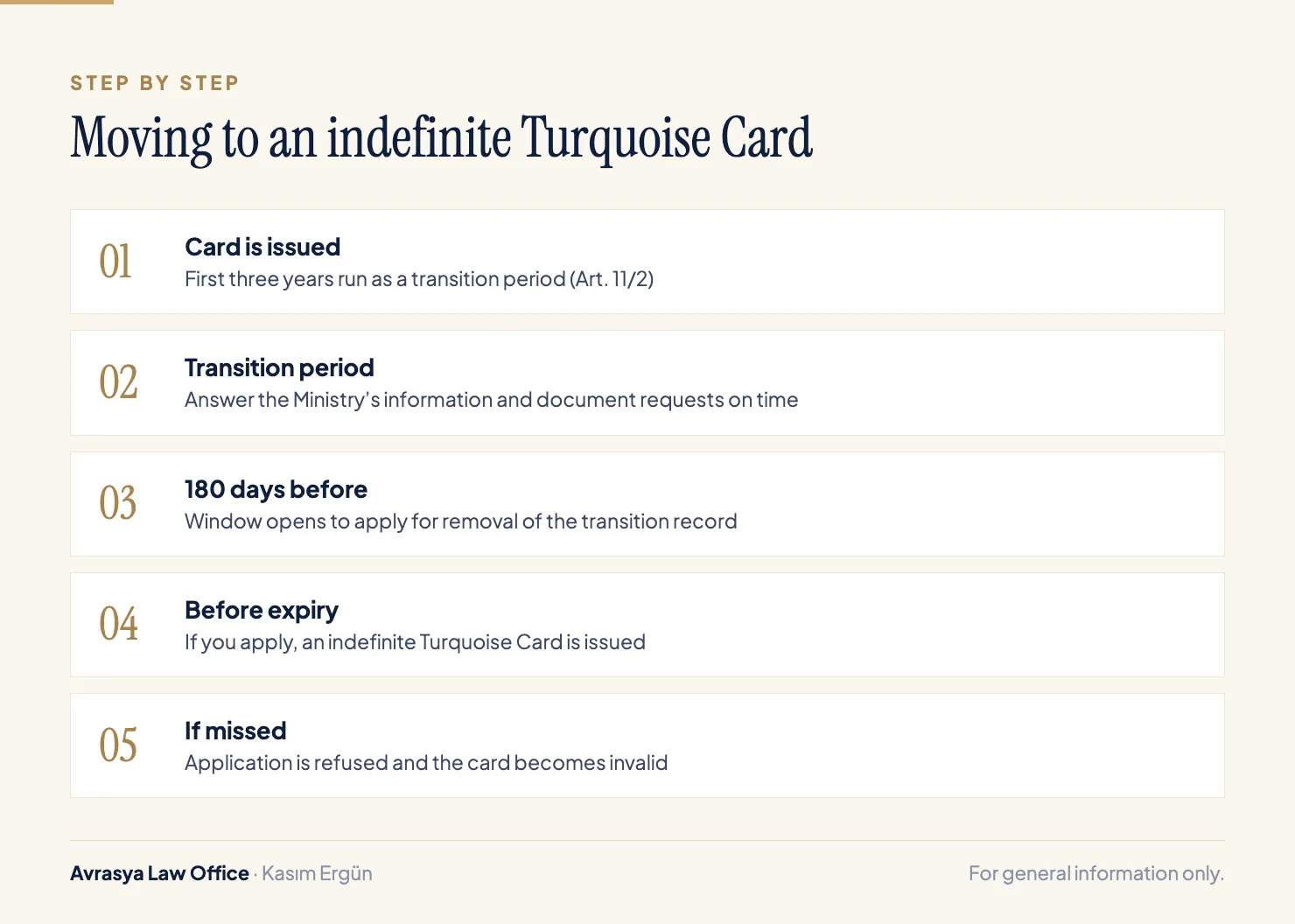
It must be stressed that the transition period does not end automatically. The system provided for by the law is as follows:
- A card that has not been cancelled during the transition period is cleared of the transition record not automatically, but only when the foreigner applies, and an indefinite Turquoise Card is then issued to the cardholder.
- The application window opens one hundred and eighty days before the transition period ends; the application must in any event be made before the period expires.
- If the deadline is missed, the application is refused and the card loses its validity (Art. 11/2).
In practice, the most serious losses of rights happen when this window is overlooked. On the day you receive the card, note in your calendar the date it was issued and the day the transition period will end.
Step-by-step roadmap
- Identify your group: Clarify which of the five groups in Regulation Art. 5 you fall into and confirm that you are not under temporary protection.
- Prepare the file: Gather the documents suited to your group; if possible, obtain a certificate of eligibility from the relevant public institution.
- Apply through the right channel: If you are in Turkey, use the Ministry’s electronic system; if you are abroad, use the Turkish diplomatic mission.
- Record the decision and the notification date: In the case of a negative decision, the thirty-day objection period starts with notification (tebliğ).
- Manage the transition period: Throughout the three years, respond to the Ministry’s information and document requests on time and maintain the qualifications on which the card was granted.
- Apply for the indefinite card: File your application within the window that opens 180 days before the period ends, and before the period expires.
What rights does the Turquoise Card provide?
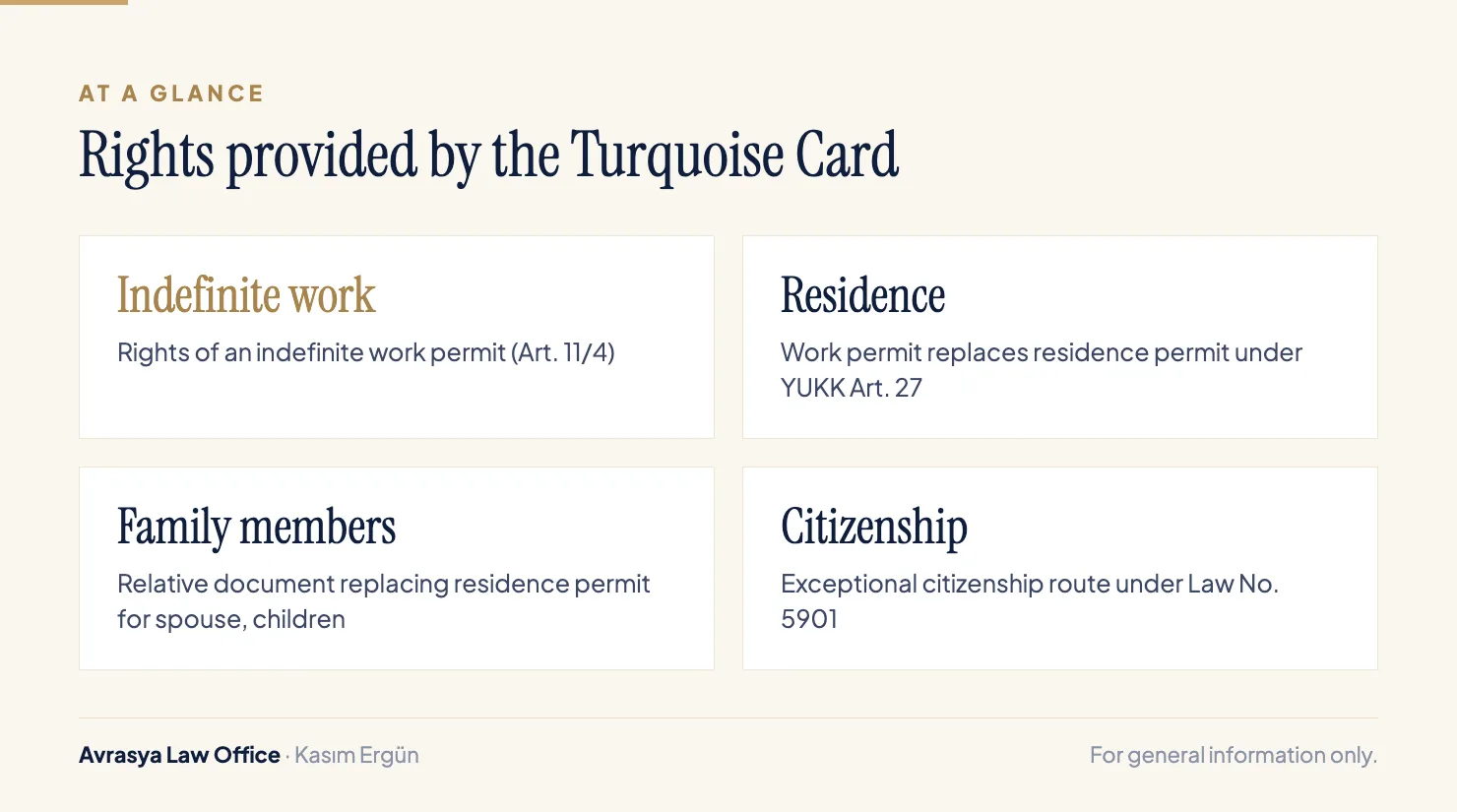
- Right to work: The cardholder has the same rights as an indefinite work permit holder (Art. 11/4).
- Rights equivalent to long-term residence: The law grants a foreigner holding an indefinite work permit all the rights afforded to long-term residence permit holders. Subject to the provisions of special laws, the holder also benefits from the rights granted to Turkish citizens; however, they do not have the right to vote, to stand for election or to enter public service, and they have no military service obligation (Art. 10/4).
- No separate residence permit needed: Law No. 6735 Art. 12/1 provides that work permits count as residence permits pursuant to Article 27 of Law No. 6458 on Foreigners and International Protection (YUKK). The cardholder therefore does not need to obtain a separate residence permit.
- Status of family members: The cardholder’s spouse and dependent children are issued a document showing their status as a “relative of a Turquoise Card holder”, which replaces a residence permit (Art. 11/3). Whether the document also gives family members the right to work requires a separate assessment. For the family’s general residence options, see our family residence permit guide.
- Route to citizenship: Turkish Citizenship Law No. 5901 lists Turquoise Card holders and their foreign spouses and children among the persons who may acquire citizenship through the exceptional route. Here too, meeting the conditions does not create an absolute right; citizenship is granted by Presidential decision. You can find general information about the process on our Turkish citizenship application page.
When is the Turquoise Card cancelled?
Under Law No. 6735 Art. 15/2, the general cancellation grounds provided for work permits also apply to the Turquoise Card. The grounds cardholders should particularly be aware of are:
- Failure to provide the information and documents requested during the transition period, or a finding that the qualifications on which the card was granted have been lost (Art. 15/2-e).
- Staying abroad longer than the period set by the Ministry (Art. 15/2-h). The Regulation sets this limit, except in cases of force majeure, at two consecutive years.
- A later discovery that false or misleading information or documents were used in the application (Art. 15/2-d).
- Notification by the Ministry of Interior that the foreigner falls within the scope of YUKK Art. 7, 15 and 54, or poses a risk in terms of public order, security or public health (Art. 15/2-f, g).
- A finding of unlawful employment (Art. 15/2-c).
Cancellation of the card does not concern the cardholder alone; the documents held by the family that replace residence permits may also be affected. For this reason, as soon as the cancellation notice is received, the family’s lawful stay in Turkey should be addressed at the same time. Where a risk of deportation arises, our objection to a deportation decision page may offer guidance.
What happens if a Turquoise Card is refused or cancelled?
Refusal and cancellation decisions are notified to the person concerned in accordance with the procedure set out in Notification Law No. 7201 (Tebligat Kanunu) (Art. 21/1). An objection may be filed with the Ministry within thirty days from the date of notification; if the objection is rejected, the dispute may be taken to the administrative courts (Art. 21/2). Under Article 7 of Administrative Procedure Law No. 2577 (İYUK), an annulment action must, as a rule, be filed within 60 days.
We explain the objection petition and annulment action stages in detail in our guide on objecting to a work permit refusal and filing an annulment action. If the reason for refusal is an insufficient score, completing the missing qualifications and reapplying often produces a faster result; there is no provision in the law prohibiting a new application.
What are the common mistakes in the Turquoise Card process?
- Not marking the 180-day application window for the indefinite card in the calendar and missing the deadline.
- Leaving unanswered the information and document requests received from the Ministry during the transition period.
- Failing to deliver the commitment on which the card was granted, for example the promised investment or employment.
- Not taking into account that staying abroad for a long time may be a ground for cancellation.
- Missing the thirty-day objection period after a refusal decision has been notified.
Frequently Asked Questions
What is the difference between the Turquoise Card and a standard work permit?
A standard work permit is granted for a fixed term and is tied to a specific employer and workplace; the first permit is issued for a maximum of one year, and extensions involve periods of two and three years. A Turquoise Card holder, by contrast, enjoys the rights of an indefinite work permit holder (Law No. 6735 Art. 11/4), and the card makes it possible for the holder’s spouse and dependent children to receive a document that replaces a residence permit.
Is a specific investment amount required to obtain a Turquoise Card?
The law does not set a fixed amount for investors. In investor applications, the level of investment, exports and employment created is assessed in the points system together with the sector and region of the investment. Because the current criteria are set by the Ministry and may change over time, investment plans should not be built on fixed figures circulating online, and the file should be supported with documents showing the actual impact of the investment.
Does the Turquoise Card automatically become indefinite when the three-year transition period ends?
No. The cardholder must personally apply for the transition record to be removed. This application becomes possible 180 days before the transition period ends and must be completed before the period expires. An application made after the deadline is refused, and the card loses its validity (Law No. 6735 Art. 11/2).
Can the spouse and children of a Turquoise Card holder stay in Turkey?
Yes. The cardholder’s spouse and dependent children are issued a document showing their status as a relative of a Turquoise Card holder, and this document replaces a residence permit (Law No. 6735 Art. 11/3). Whether the document also gives family members the right to work is a separate question that requires its own assessment.
Can Turkish citizenship be acquired with a Turquoise Card?
Turkish Citizenship Law No. 5901 lists Turquoise Card holders and their foreign spouses and children among the persons who may acquire citizenship through the exceptional route. However, meeting the conditions for exceptional citizenship does not give the person an absolute right; citizenship is granted by Presidential decision and the decision lies within the discretion of the administration. For this reason, it is useful to have the file assessed in all its aspects before applying.
In which cases can a Turquoise Card be cancelled?
The main grounds for cancellation are failure to submit the information and documents requested during the transition period, loss of the qualifications on which the card was granted, staying abroad longer than the period set by the Ministry, discovery that false or misleading documents were used in the application, notification of an objection on grounds of public order or security, and a finding of unlawful employment (Law No. 6735 Art. 15/2).
What can be done if a Turquoise Card application is refused?
An objection may be filed with the Ministry within thirty days from the date of notification (tebliğ) of the refusal decision; if the objection is also rejected, the dispute may be taken to the administrative courts (Law No. 6735 Art. 21/2). Under Article 7 of the İYUK, an annulment action must, as a rule, be filed within 60 days. If the refusal is based on an insufficient score, reapplying after completing the missing qualifications may also be considered.
Conclusion
The Turquoise Card is an important status that gives qualified foreigners the opportunity to work in Turkey in the long term and to live there with their families. However, the card is granted on the basis of a points assessment, and the administration’s scope of discretion is broad. Monitoring the obligations during the three-year transition period, not missing the 180-day application window and observing the thirty-day objection period in the event of refusal or cancellation are decisive for protecting the rights acquired.
At Euroasia Law Office in Bakırköy, we work in the field of migration and foreigners law with foreign executives, investors and the companies that employ them. If you would like your situation regarding an application, the transition period or a cancellation decision to be assessed, you can request a preliminary consultation through our contact page. As legislation and practice may change, this content is for general information purposes only and does not constitute legal advice.
Related Guides
- Work Permits for Foreigners
- Work Permit Refusal: Objection and Annulment Action
- Family Residence Permit
- Turkish Citizenship Application
- What to Do If Your Residence Permit Is Refused
Legislation and Official Sources
- International Labour Force Law (6735): Art. 3, 10, 11, 12, 15, 21
- Turquoise Card Regulation, Official Gazette 14.03.2017: Art. 5, 10, 11
- Law No. 6458 on Foreigners and International Protection (Art. 7, 15, 27, 54)
- Turkish Citizenship Law No. 5901
- Administrative Procedure Law No. 2577 (Art. 7)
- Notification Law No. 7201
- Ministry of Labour and Social Security