For a foreign student enrolling at a university in Turkey, the questions are usually the same: What happens if my enrolment is cancelled, can I work while studying, and can I stay in the country after I receive my diploma? The answer to all of them lies in how the student residence permit (öğrenci ikamet izni) regime is structured. In this guide we explain, in order, who is granted the permit, the application and extension timeline, the grounds for cancellation, the possibility of working and which status you can move to after graduation.
Short answer: Foreigners who will study at a university in Turkey at doctoral, master’s, bachelor’s or associate degree level obtain a student residence permit under Article 38 of the YUKK. If the studies can no longer be continued or the permit is used for another purpose, it may be cancelled (Art. 40). The permit does not include the right to work; a separate work permit is required (Art. 41). A foreigner who receives a diploma and applies within six months may become eligible for a short-term residence permit, granted only once and valid for a maximum of one year (Art. 31/1-i, 31/4).
What Is a Student Residence Permit in Turkey and Who Is It Granted To?
When Law No. 6458 on Foreigners and International Protection (YUKK) divides residence permits into types, it lists the student permit as a separate category; in other words, it is not a sub-type of the short-term, family or long-term permit (Art. 30/1-c). The student therefore does not need to base their stay in Turkey on another permit; the purpose of study is a ground for residence in its own right.
The Law groups the students who can benefit from this permit into three categories. Which category you fall into directly affects the duration of the permit and how it is issued.
- Higher education students: Foreigners who will study in Turkey at university level (associate, bachelor’s, master’s or doctoral degree) are granted the permit (Art. 38/1). The wording of the Law here points not to discretion but to granting the permit to a student who meets the requirements.
- Primary and secondary school students: Foreign children whose care and expenses are covered by a natural or legal person may be granted a permit with the consent of their parent or legal representative; throughout their studies this permit may be issued and renewed in one-year periods (Art. 38/2).
- Students arriving through public institutions: Foreigners who come to Turkey to study through a public institution or body may also be granted a permit for as long as their education continues (Art. 38/5).
If the studies will last less than one year, the permit cannot be issued for a period exceeding the duration of the studies (Art. 38/4). Students arriving on exchange programmes, on the other hand, are in practice mostly handled under the short-term residence permit (Art. 31/1-d).
Does a student residence permit give rights to the family?
It does not. The student’s permit does not create any right for their mother, father or other relatives to obtain a residence permit (Art. 38/3). A mother, father or other relative who wishes to live in Turkey with the student must apply for another type of permit that fits their own situation. For the requirements on family reunification, see our family residence permit guide (aile ikamet izni).
What Are the Student Residence Permit Requirements and Which Documents Are Needed?
YUKK Art. 39/1 sets out three basic requirements for a student residence permit. These requirements apply both at the first application and throughout the validity of the permit; if one of them ceases to exist, the future of the permit is affected.
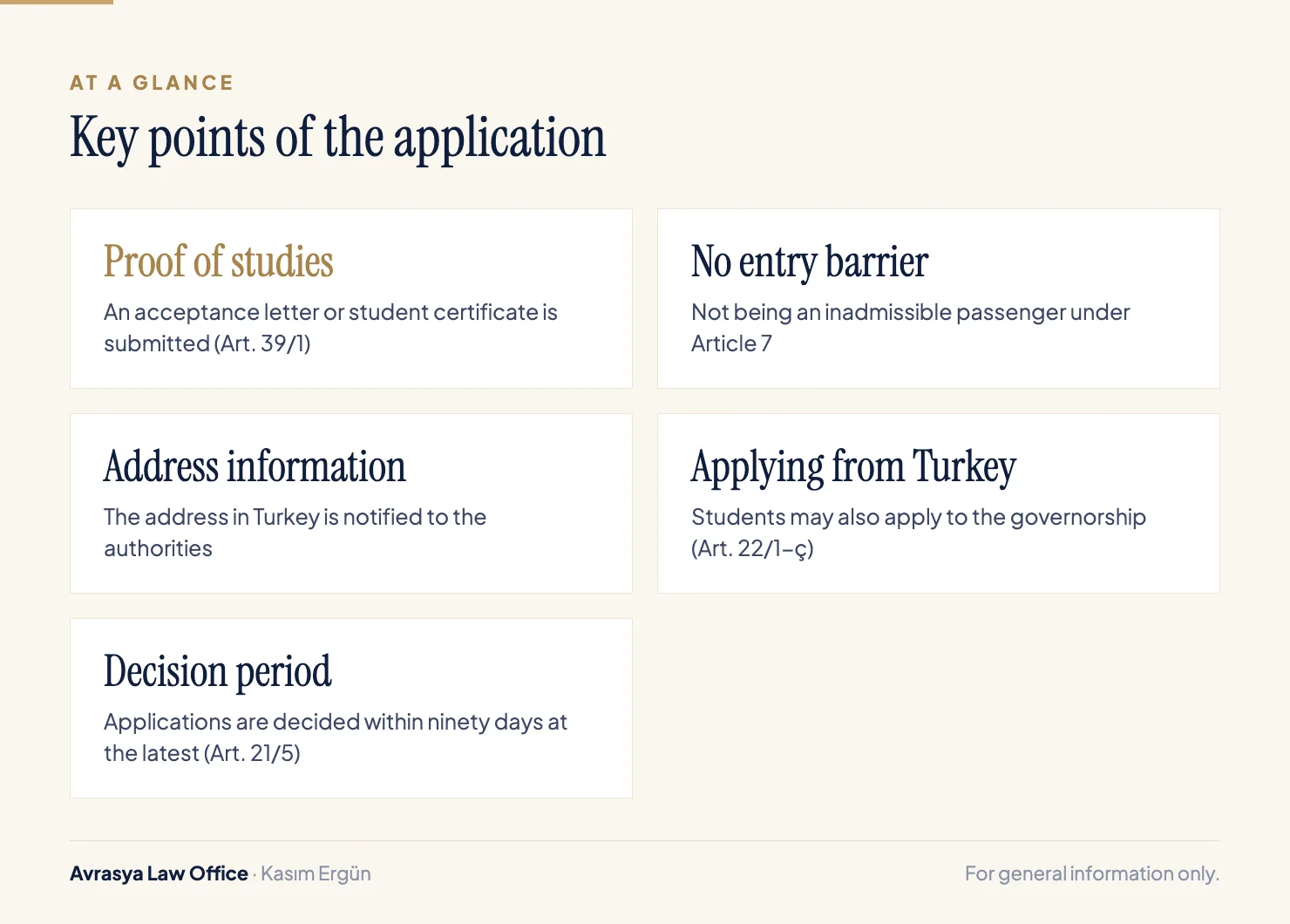
| Statutory requirement (Art. 39/1) | What does it mean? |
|---|---|
| Information and documents on the studies | Submitting documents showing the studies, such as an acceptance letter or student certificate |
| Not falling under Article 7 | Not being an inadmissible passenger; for example, not facing an entry ban |
| Address information | Notifying the authorities of the address where you will stay in Turkey |
In practice, in addition to these three requirements, documents such as a passport, biometric photographs, health insurance, and the fee and card charge are also requested. Since the Directorate General of Migration Management (Göç İdaresi) may update the document list, you should check the current list before applying.
Where and when is the application made?
As a rule, a residence permit application is made to the Turkish consulate in the country where the foreigner is located. The student residence permit is one of the exceptions to this rule: the application may also be made in Turkey to the governorship, that is, the Provincial Directorate of Migration Management (Art. 22/1-ç).
A residence permit is mandatory for every foreigner whose stay in Turkey will extend beyond the visa, the visa exemption or ninety days (Art. 19/1). It is therefore important for the student to complete the application before the visa expires. The authorities decide on applications within ninety days at the latest (Art. 21/5).
How Is a Student Residence Permit Extended?
Because in higher education the duration of the permit is tied to the duration of the studies, an extension may become necessary as long as the studies continue. An extension application can be filed from sixty days before the permit expires and must in any case be made to the governorship before the permit ends (Art. 24/2).
The foreigner who applies is given a document; with this document it is possible to remain in Turkey until a decision is made, even if the permit has expired. This protection depends on the application being made on time.
What happens if the extension is refused?
A foreigner whose extension is refused and who does not leave the country within ten days becomes subject to a deportation decision (Art. 54/1-j). A foreigner who stays in the country for more than ten days after the permit has ended without a justified reason may face the same consequence (Art. 54/1-g). These two rules make it necessary to track enrolment renewal and residence extension dates on the same calendar.
When Is a Student Residence Permit Refused or Cancelled?
YUKK Art. 40/1 brings together in a single list the cases in which a student residence permit will not be granted, will be cancelled if granted, and will not be extended:
- the requirements listed in Art. 39 are not met at all or later cease to exist,
- evidence emerges showing that the studies cannot be continued (such as cancellation of enrolment or long-term absence),
- it is established that the permit is being used for a purpose other than the one for which it was granted (for example, working without authorisation instead of studying),
- there is a valid deportation decision or an entry ban to Turkey against the foreigner.
The most common scenario in practice is the cancellation of the permit after enrolment is frozen or cancelled. It is known in practice that higher education institutions report enrolment changes to the authorities. A student facing an enrolment problem would therefore be well advised to assess residence options that fit their new purpose of stay before a cancellation notification (tebliğ) arrives.
When the governorship decides on a refusal or cancellation, it takes into account the foreigner’s family ties, how long they have resided in Turkey, the conditions in their country of origin and the best interests of the child; the decision may be postponed (Art. 25/1). The decision is notified to the foreigner or their lawyer, and the notification states the rights of objection (Art. 25/2).
What awaits a student whose residence permit is cancelled?
A foreigner whose permit is cancelled is included in the Law’s list of persons to be deported (Art. 54/1-f). If such a deportation decision is made, you may file a lawsuit before the administrative court within seven days from the day the decision is notified to you (Art. 53/3; the article was amended by Law No. 7533). The refusal or cancellation of the permit, on the other hand, may be brought before the courts through a separate annulment action; the general time limit for this under Article 7 of Administrative Procedure Law No. 2577 (İYUK) is 60 days.
These two routes have different time limits and different counterparties; using one does not stop the time limit of the other. For details, see our pages on what to do if a residence permit is refused and objecting to a deportation decision.
Can International Students Work in Turkey?
They can, but only by obtaining a work permit. YUKK Art. 41/1 provides that university students in formal education (from associate degree to doctorate) may work only by obtaining a work permit. The student residence permit does not, on its own, include the right to work.
- Associate and bachelor’s degree students: These students may work only after completing their first year of study; the details of the practice are determined by the relevant laws and Presidential decrees (Art. 41/1). The “twenty-four hours per week” cap in the original text of the article was removed by International Labour Force Law No. 6735; for the hour limit in force today, the secondary legislation must be consulted.
- Master’s and doctoral students: The Law does not provide for a first-year waiting period for these students; they can work once they obtain a work permit.
A deportation decision may be made against a student found to be working without a work permit (Art. 54/1-ğ). The same situation may also lead to cancellation of the student residence permit on the ground of use for a different purpose (Art. 40/1-c). For the employer, there is a risk of an administrative fine. To see how the work permit process works, you can review our work permit for foreigners page.
Is It Possible to Stay in Turkey After Graduation?
With graduation, the basis of the student residence permit falls away. However, the Law opens a special transition route for foreigners who complete their higher education in Turkey.
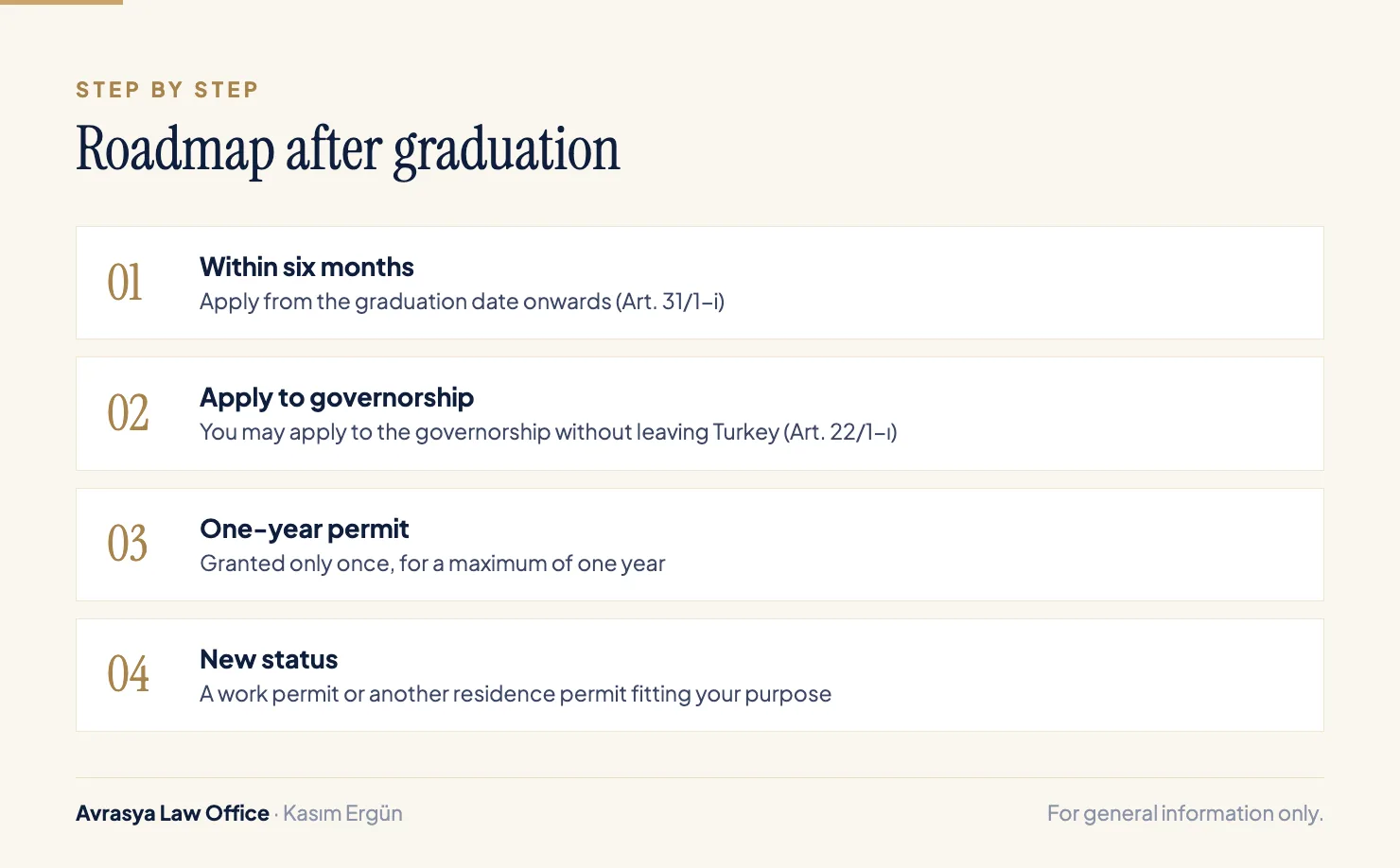
- A graduate who applies within six months following the diploma date may be granted a short-term residence permit (Art. 31/1-i).
- This option can be used only once, and the permit may be valid for a maximum of one year (Art. 31/4).
- The application can be made to the governorship without leaving Turkey (Art. 22/1-ı).
The graduate can use this year to find a job, apply for a work permit or prepare to move to a different type of residence. For a graduate who finds a job and obtains a work permit, that permit also counts as a residence permit (Art. 27/1). A person whose reason for staying in Turkey changes may request the type of permit that fits their new situation (Art. 29/1); in the case of marriage to a Turkish citizen, this may be a family residence permit.
Does Time Spent as a Student Count Towards Long-Term Residence?
When calculating the period of uninterrupted residence, half of the time spent on a student residence permit and all of the time spent on other residence permits is taken into account (Art. 28/2). Accordingly, a four-year bachelor’s degree period counts as two years towards the eight-year long-term residence requirement.
Stays abroad exceeding six months within one year, or a total of one year within the last five years, in principle interrupt the period. Periods spent abroad for education, however, are excluded from this interruption calculation (Art. 28/1). The effect of student periods on the five-year period required for a citizenship application through the general route should be examined separately; our Turkish citizenship application page offers a general framework on this subject.
How Does the Student Residence Permit Process Work Step by Step?
- Obtain your acceptance and enrolment documents: An acceptance letter or student certificate showing your studies is the first requirement under Art. 39/1.
- Check the current document list: Prepare documents such as your passport, biometric photographs, health insurance, and the fee and card charge according to the current list of the Directorate General of Migration Management.
- Apply before your visa expires: For the student residence permit, the application can be made in Turkey to the governorship (Art. 22/1-ç); provide your address information in full.
- Align the extension timeline with your enrolment timeline: You can apply for an extension from sixty days before the permit expires, and you must apply before it ends (Art. 24/2).
- Obtain a work permit before working: If you are an associate or bachelor’s degree student, wait until your first year is completed (Art. 41/1).
- If there is an enrolment problem, assess new options immediately: Identify the permit type that fits your purpose of stay without waiting for a cancellation notification.
- Apply within six months after graduation: Apply to the governorship for the one-time short-term permit valid for a maximum of one year (Art. 31/1-i, 31/4).
What Are the Common Mistakes with a Student Residence Permit?
- Leaving enrolment renewal and extension to the last minute: An application made after the permit has expired does not provide the protection of remaining until a decision is made.
- Waiting while enrolment is cancelled or frozen: Every day that passes without researching a new residence option increases the risk of cancellation and deportation.
- Working part-time without a permit: This may count both as a ground for deportation and as use of the permit for a different purpose.
- Missing the six-month period after graduation: The possibility of moving to short-term residence depends on this period.
- The family relying on the student’s permit: The student’s permit does not give relatives the right to stay in Turkey (Art. 38/3).
Frequently Asked Questions
How long is a student residence permit granted for?
A permit granted for higher education is set according to the duration of the studies. For foreign children in primary and secondary education, however, the permit is granted for one-year periods and extended for the same periods (YUKK Art. 38/2). If the studies will last less than one year, the duration of the permit cannot exceed the duration of the studies (Art. 38/4). You should therefore track the expiry date of the permit together with your enrolment calendar.
What happens to my student residence permit if my enrolment is cancelled?
Under Article 40/1-b of Law No. 6458, the emergence of evidence showing that the studies cannot be continued is among the grounds for cancelling a student residence permit. Cancellation of enrolment may be assessed within this scope. In such a case, rather than waiting for the cancellation notification, it is advisable to research without delay a residence permit option that fits your new purpose of stay.
Can I work with a student residence permit?
A student residence permit does not by itself grant the right to work; students in formal education may work only by obtaining a work permit (YUKK Art. 41/1). For associate and bachelor’s degree students, this possibility arises after the first year is completed. The Law does not provide for a first-year waiting period for master’s and doctoral students; they too can work with a work permit.
Can I stay in Turkey after I graduate?
A foreigner who completes university in Turkey may obtain a short-term residence permit if they apply within six months after the date of receiving their diploma (YUKK Art. 31/1-i). This permit is granted only once and for a maximum of one year (Art. 31/4). You can apply to the governorship without leaving the country and use this period to look for a job.
Can my family stay in Turkey on the basis of my student residence permit?
No. YUKK Art. 38/3 expressly states that a student residence permit does not create a right of residence for the mother, father or other relatives. Family members who wish to stay with you must apply for a separate type of permit that fits their own reason for being in Turkey; your permit is not considered a basis on their behalf.
What should I do if my student residence permit is cancelled?
You can take the cancellation decision to the administrative court; the general time limit for filing a lawsuit under Article 7 of İYUK No. 2577 is 60 days. If a deportation decision has also been made against you, the time limit for that decision is much shorter: you must apply to the court within seven days from notification (YUKK Art. 53/3).
When should I apply for an extension?
An extension application can be filed from sixty days before the permit expires and must in any case reach the governorship before the permit ends (YUKK Art. 24/2). With the document issued after the application, you may remain in Turkey until a decision is made, even if the permit has expired. Tracking your new term enrolment on the same calendar also reduces the risk.
Does time as a student count towards long-term residence?
It does, but not in full. Under YUKK Art. 28/2, half of the time spent on a student residence permit and all of the time spent on other residence permits is taken into account in calculating uninterrupted residence. For example, a four-year bachelor’s degree period counts as two years towards the eight-year long-term residence requirement.
Conclusion
A foreign student’s legal presence in Turkey largely depends on the student residence permit, and that permit depends on the studies actually continuing. A cancelled enrolment, unauthorised work or a missed extension date can lead to cancellation, and cancellation can lead to deportation proceedings. The six months after the diploma, meanwhile, is a period that a graduate who wishes to stay in the country must follow carefully.
Euroasia Law Office in Bakırköy works on immigration law matters with international students, their families and schools. For your permit application, a cancellation decision notified to you or your transition plan after graduation, you can request a preliminary consultation through our contact page or review our Immigration and Foreigners Law page. As legislation and case law may change over time, this article provides general information; it does not replace legal advice on your specific case.
Related Guides
- What to Do If Your Residence Permit Is Refused
- Family Residence Permit
- Work Permit Refusal: Objection and Annulment Lawsuit
- Turquoise Card (Turkuaz Kart)
- Objecting to a Deportation Decision
Legislation and Official Sources
- Law on Foreigners and International Protection (6458) (Art. 7, 19, 21, 22, 24, 25, 27, 28, 29, 30, 31, 38, 39, 40, 41, 53, 54)
- International Labour Force Law No. 6735
- Administrative Procedure Law No. 2577 (Art. 7)
- Presidency of Migration Management