If you have received a notification stating that "your application has been concluded negatively", whether you are an employer hiring a foreign national or a foreign national working in Turkey, your first question is most likely this: what do we do now? A work permit refusal, when read correctly, is often an administrative decision that can be overcome; however, the deadlines are short and the available routes differ from one another. In this guide we explain, in order, the grounds for refusal, the objection to the Ministry, the annulment lawsuit before the administrative court, the option of reapplying, and the effect of the decision on residence status.
Short answer: Against the refusal of a work permit application or the cancellation of an existing permit, an objection can be filed with the Ministry of Labour and Social Security within 30 days following the date of notification (tebliğ); if the objection is rejected, an annulment lawsuit can be filed in the administrative courts (International Labour Force Law No. 6735, Art. 21/2). Where no special time limit applies, the time limit for filing a lawsuit before the administrative court is 60 days (Administrative Procedure Law No. 2577 (İYUK), Art. 7). For refusals based on missing documents or unmet criteria, a complete new application comes to the fore; for refusals based on discretion or security, an objection and a lawsuit do.
Why is a work permit refused?
The grounds for refusal are not arbitrary; Art. 9/1 of International Labour Force Law No. 6735 lists them one by one. Under the law, an application is refused in the following cases:
- The application is incompatible with the international labour force policy,
- False or misleading information or documents are used in the application,
- The justification for employing the foreign national is not found sufficient,
- The application concerns a job or profession reserved exclusively for Turkish citizens by other laws,
- It is established that the foreign national does not have the required qualifications and expertise,
- The evaluation criteria set by the Ministry are not met,
- The Ministry of Interior notifies that the foreign national falls within the scope of Articles 7, 15 or 54 of Law No. 6458 on Foreigners and International Protection (YUKK),
- The foreign national's employment in Turkey is considered objectionable in terms of public order, public security or public health,
- The application is made, without a favourable opinion from the Ministry of Foreign Affairs, for a citizen of a country that Turkey does not recognise or with which it has no diplomatic relations,
- The application is not made within the statutory period or its deficiencies are not remedied.
Which grounds for refusal are seen most often in practice?
Although the list in the law is long, a large share of files are concentrated on a few grounds. Knowing which one is cited in the refusal letter is a precondition for choosing the next step.
| Ground for refusal | What does it mean? | Legal basis |
|---|---|---|
| Evaluation criteria | Criteria such as the number of Turkish citizens employed at the workplace, the company's capital or turnover, or the wage to be paid to the foreign national are not met; this is the most common ground for refusal. | 6735 Art. 7/6 |
| Missing documents | If information or documents are missing from the file, the evaluation is postponed; this postponement cannot exceed thirty days except in documented force majeure, and if the deficiencies are not remedied, the application is refused. | 6735 Art. 7/7 |
| Late extension application | An extension application can be made starting sixty days before the permit expires and must in any case be submitted before the permit expires; a late application is refused. | 6735 Art. 7/3 |
| Lack of preliminary permission | In fields requiring professional competence such as health and education, the application cannot be concluded positively unless preliminary permission is obtained from the relevant ministry, and for foreign academic staff from the Council of Higher Education; extensions are also subject to preliminary permission. | 6735 Art. 8 |
| Security and public order | The existence of a restriction record concerning the foreign national, a deportation decision, or an assessment relating to public order; the reasoning is often not disclosed openly. | 6735 Art. 9/1-f, g |
In security-based refusals, the applicant often cannot know what they are facing. In such files, the lawsuit stage also serves to bring to light the reasoning the administration relied on.
To whom is the refusal decision notified, and when does the time limit start?
The Notification Law No. 7201 (Tebligat Kanunu) applies to the notification of refusal and cancellation decisions. In dependent employment, the addressee is the employer employing the foreign national; for foreign nationals holding an independent work permit, an indefinite work permit or a Turquoise Card (Turkuaz Kart), the addressee of the decision is the foreign national themselves (Art. 21/1).
The practical consequence is this: in dependent employment, the objection period as a rule starts running with the notification made to the employer. For this reason, the employer needs to regularly check its electronic notification address and the notifications in the application system (e-İzin), and record the date of notification in writing.
Which time limits apply after a work permit refusal?
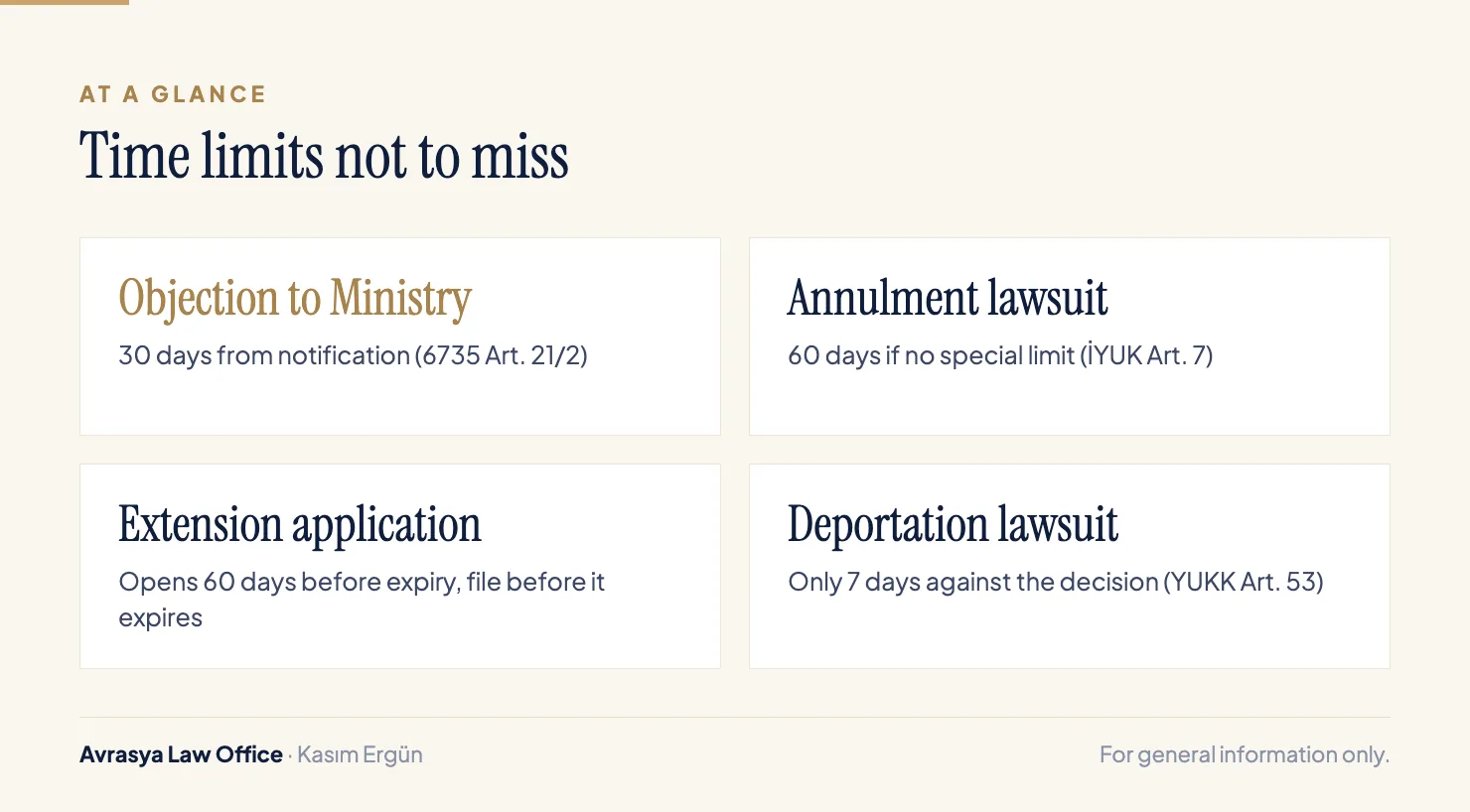
The most frequent cause of loss of rights in this area is confusing the time limits with one another. The table below brings together the time limits mentioned in this article:
| Action | Time limit | Legal basis |
|---|---|---|
| Objection to the Ministry | 30 days from notification | 6735 Art. 21/2 |
| Annulment lawsuit against rejection of the objection | 60 days if no special time limit applies | İYUK (Law No. 2577) Art. 7 |
| Postponement for missing documents | At most 30 days, except force majeure | 6735 Art. 7/7 |
| Extension application | Opens 60 days before expiry, must be filed before the permit expires | 6735 Art. 7/3 |
| Lawsuit against a deportation decision | 7 days | YUKK Art. 53 |
How do you object to a work permit refusal?
Under Law No. 6735, those concerned may object to the decisions of the Ministry before the Ministry within thirty days from the date of notification (Art. 21/2). The objection is the first and fastest stage, allowing the decision to be re-examined within the administration.
How should the objection petition be prepared?
The success of an objection depends largely on how closely the petition addresses the ground for refusal. The main points to watch are:
- Target the reasoning: Whatever sub-paragraph or criterion is cited in the refusal letter, the objection must answer that point. Generic template texts meant to fit every file usually do not work.
- Cure the deficiency with documents: Documents such as diploma equivalence, the employment contract, company records and social security (SGK) declarations should be attached to the petition.
- Make the contribution concrete: In refusals where the employment justification was found insufficient, the foreign national's languages, technical expertise, connection to exports or investment, and qualifications not available in Turkey should be shown with documents.
- Raise procedural irregularities separately: For example, if a refusal was issued directly without a postponement for missing documents, this should be argued separately as a breach of Art. 7/7.
How is an annulment lawsuit filed if the objection is rejected?
If the Ministry rejects the objection, the law keeps the route to the administrative courts open (Art. 21/2). Where no special time limit is provided, the time limit for filing a lawsuit before the administrative court is 60 days under Art. 7 of Administrative Procedure Law No. 2577. If the Ministry does not respond to the objection at all within the time allowed, the implied rejection rules of the İYUK come into play; this period must not be overlooked either.
What to expect during the lawsuit
- Statement of claim: The annulment of both the initial refusal decision and the decision rejecting the objection is requested. The unlawfulness of the decisions in terms of competence, form, grounds, subject matter and purpose is explained concretely.
- Stay of execution: Where irreparable or impossible-to-remedy harm and clear unlawfulness exist together, a stay of execution of the decision can be requested (İYUK Art. 27). This request is particularly important in files where the foreign national will lose the right to legal stay because of an extension refusal.
- Bringing the reasoning to light: In refusals based on security or public order, the court may ask the administration for the information and documents underlying the decision. Abstract reasoning not supported by documents can be questioned under judicial review.
- Appeal: An appeal (istinaf) can be lodged against the administrative court's decision.
One point should not be forgotten: an annulment ruling does not automatically give the foreign national a work permit. After the ruling, the Ministry must take a new action in line with it.
Which route should you choose: objection, lawsuit or new application?
There is no statutory provision prohibiting a new application after a refused one. The real factor determining which route to choose is the ground for refusal:
| Type of refusal ground | Route that usually comes to the fore |
|---|---|
| Missing documents or unmet criteria (e.g. the number of Turkish employees at the workplace being completed later) | A complete new application is often the fastest solution. |
| Discretion-based grounds (e.g. insufficient employment justification, lack of qualifications and expertise) | An objection and, if necessary, judicial review of the decision through an annulment lawsuit. |
| Security grounds, a restriction code or a notification under YUKK Art. 54 | The first step is to examine the restriction record and, if there is a deportation decision, its legal status. |
| Extension application filed after the deadline | Since an extension is no longer possible, a new (first) application; legal stay is planned separately. |
In security-based files, the problem is actually not the work permit but the foreign national's record with the migration authority. Every application made before this record is resolved will be refused on the same ground; for the nature of the record, see our restriction code guide.
These options do not always exclude one another. However, if an objection, a lawsuit and a new application are to be pursued at the same time, the strategy must be set up from the outset so that they do not undermine each other.
What happens to residence and deportation risk if a work permit is refused?
Under Art. 12/1 of Law No. 6735, pursuant to YUKK Art. 27 a work permit also replaces a residence permit. Consequently, an extension refusal or the cancellation of the permit can also remove the basis for the foreign national's legal presence in Turkey. In this case, the possibility of switching to another type of residence permit should be assessed without delay; for the residence side of the process, our article What to Do If a Residence Permit Is Refused? may serve as a guide.
Continuing to work after a refusal decision means unauthorised employment. In this case, administrative fines may be imposed on both the employer and the foreign national, and deportation proceedings may also be initiated for the foreign national (Art. 23). If a deportation decision is issued against the foreign national, the time limit for filing a lawsuit against it is only 7 days (YUKK Art. 53); for this route, see our page on challenging a deportation decision.
What can be done if an existing work permit is cancelled?
If a permit already granted is cancelled, the same Art. 21/2 routes, namely objection and lawsuit, are open. Art. 15/2 of the law lists the following among the grounds for cancellation:
- The foreign national not coming to Turkey within six months after the start date of the permit,
- The passport not being renewed,
- It being established that the foreign national worked in breach of the law,
- The foreign national's employment ending,
- It later coming to light that a forged document was used,
- The uninterrupted period of stay abroad exceeding six months for fixed-term permits, or one year for independent and indefinite permits.
In cancellation decisions based on stay abroad, force majeure reasons such as health grounds or compulsory public service can be raised as a defence.
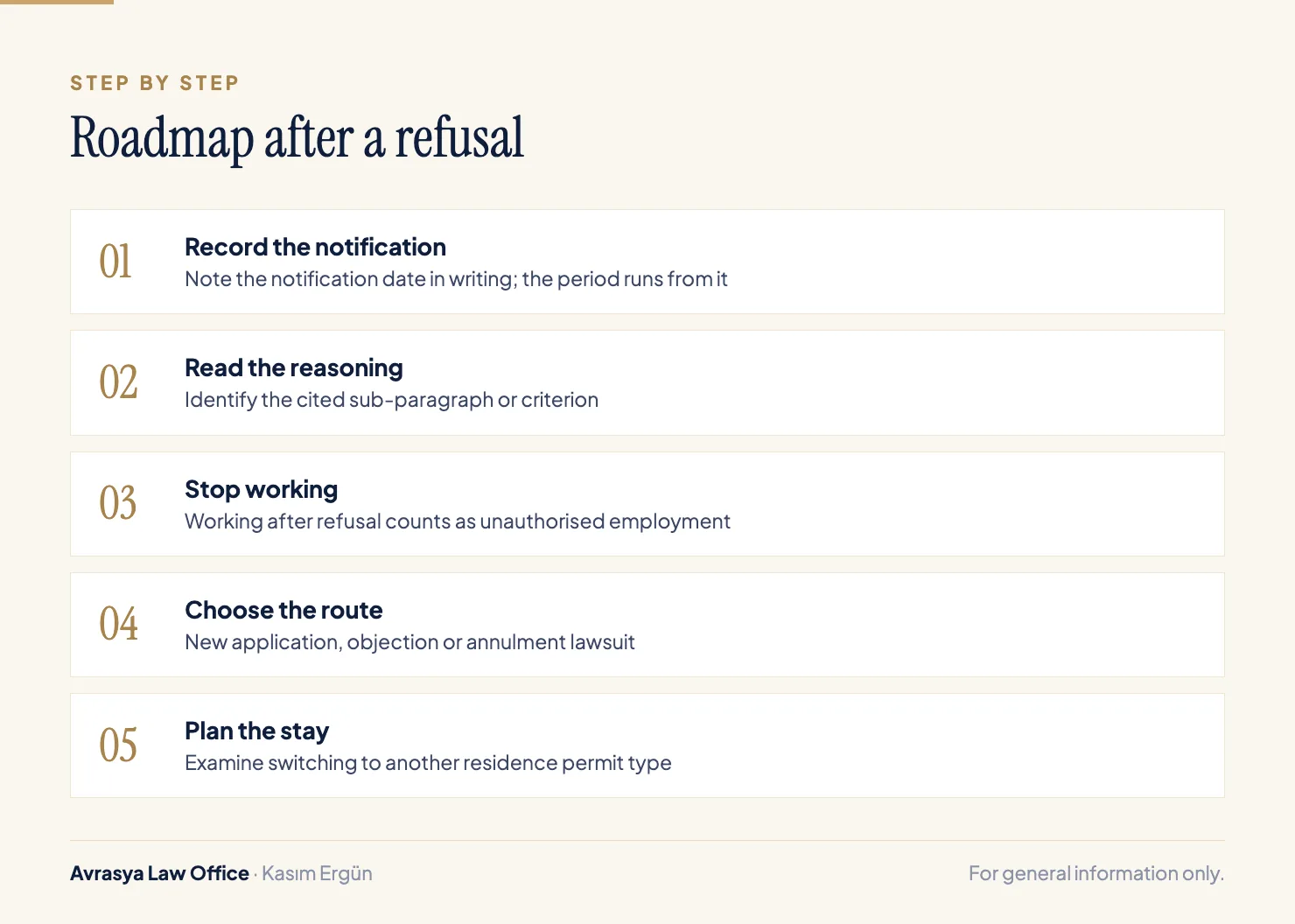
What should you do, step by step, when a refusal decision arrives?
- Record the notification date: Write down on which day the decision was notified to the employer or the foreign national; the 30-day objection period runs from this date.
- Read the reasoning: Identify which sub-paragraph or criterion is cited in the refusal letter; the whole strategy is shaped by it.
- Stop working: Continuing to work after the refusal decision counts as unauthorised employment under Art. 23.
- Choose the route: For missing documents or unmet criteria, consider a new application; for refusals based on discretion or security, consider an objection.
- File the objection on time: Submit to the Ministry a petition that focuses on the reasoning, cures deficiencies with documents and points out any procedural irregularities.
- Prepare the lawsuit: If the objection is rejected, file an annulment lawsuit before the administrative court within the 60-day time limit; request a stay of execution if necessary.
- Plan the stay: Since the work permit replaces a residence permit, immediately examine whether the foreign national can switch to another residence permit.
What are the common mistakes after a work permit refusal?
- Learning of the decision from an e-mail or a system notification and then not recording the notification date, thereby missing the thirty-day objection period,
- Reapplying with the same documents without examining the reasoning,
- Filing the extension application after the permit has expired (Art. 7/3),
- Continuing to employ the foreign national despite the refusal decision,
- In security-based refusals, dealing only with the work permit file without ever examining the restriction record.
Frequently Asked Questions
How long do I have to object to a work permit refusal?
An objection against the Ministry's refusal or cancellation decision is filed with the Ministry of Labour and Social Security within thirty days from the date the decision is notified (International Labour Force Law No. 6735, Art. 21/2). In dependent employment, notification (tebliğ) is as a rule made to the employer, so the start of the period should be tracked through the employer's records. If the objection is rejected, the second stage is an annulment lawsuit before the administrative court.
Can I file a lawsuit directly without objecting to the Ministry first?
The order set out by the law is to first object to the Ministry and, if the objection is rejected, to go to the administrative courts (Art. 21/2). Whether a lawsuit filed by skipping the objection stage would be dismissed on procedural grounds has to be assessed separately according to the circumstances of each case. Because of this uncertainty, using the thirty-day objection period is the safer starting point for preserving the later right to sue.
Can I reapply for a work permit after a refusal?
Yes. Law No. 6735 contains no provision preventing a new application after a refused one. However, a new application filed with the same documents, without removing the ground for refusal, is likely to meet the same outcome. The reasoning should be read first, the missing document or unmet criterion completed, and only then should a new application be filed with a complete file.
Can a foreign national whose extension request was refused keep working?
No. Continuing to work after a refusal decision counts as unauthorised employment. Under Art. 23 of Law No. 6735 this can lead to administrative fines for both the employer and the foreign national; for the foreign national, deportation proceedings may also follow. For this reason, work should be stopped and the foreign national's stay planned even while the objection or lawsuit is pending.
Does a work permit refusal also affect the residence permit?
It can. Under Art. 12/1 of Law No. 6735, a work permit replaces a residence permit pursuant to Art. 27 of the YUKK. This is why an extension refusal or the cancellation of an existing permit in particular can also remove the basis for the foreign national's legal presence in Turkey. The option of switching to another type of residence permit should therefore be examined without delay.
Does an annulment ruling by the administrative court mean a work permit is granted?
No. The court annulling the refusal does not automatically give the foreign national a work permit. After the annulment ruling, the Ministry must take a new administrative action in line with that ruling. For this reason, the process before the Ministry should be followed even after the lawsuit ends, and the foreign national's status of stay at that date should be considered separately.
How long does a work permit refusal lawsuit take?
It is not possible to give a definite timeframe; the length of the case depends on the court's workload and on whether a stay of execution was requested. Because of this uncertainty, when the lawsuit is filed, not only the legal arguments but also the foreign national's legal stay and the employer's workforce needs should be planned together. In urgent files such as an extension refusal, a request for a stay of execution is particularly important.
Conclusion
A work permit refusal can be remedied in most cases; this requires reading the ground for refusal correctly and not missing the thirty-day objection period. For refusals caused by deficiencies, a new and complete file is the more suitable route; for refusals based on discretion or security, an objection to the Ministry followed by an annulment lawsuit. Meanwhile, the foreign national's status of stay and the risk of unauthorised employment should not be overlooked. Since legislation and case law may change, this content is for general information purposes and does not constitute legal advice.
If, as a foreign employee or an employer hiring foreign nationals, you would like your situation regarding a refusal, cancellation or extension issue to be assessed, you can contact Euroasia Law Office for a preliminary consultation through our contact page, and you can also review our Work Permits for Foreigners page.
Related Guides
- What to Do If a Residence Permit Is Refused?
- What Is a Restriction Code?
- Turquoise Card
- Student Residence Permit
- Immigration and Foreigners Law
Legislation and Official Sources
- International Labour Force Law No. 6735 (Art. 7, 8, 9, 12, 15, 21, 23)
- Administrative Procedure Law No. 2577 (Art. 7, 27)
- Law No. 6458 on Foreigners and International Protection (Art. 7, 15, 27, 53, 54)
- Notification Law No. 7201
- Ministry of Labour and Social Security
- Presidency of Migration Management