If your spouse is a Turkish citizen yet you still have to keep leaving and re-entering on a tourist visa, if you are unsure what income is enough to bring your child to live with you, or if the migration authorities have rejected your application on the grounds that your marriage is not genuine, the answer lies in the rules on the family residence permit (aile ikamet izni). This is a specific type of residence permit designed for foreign spouses and children who wish to maintain family unity in Turkey. Below we cover its scope, the requirements, the application route, the grounds for refusal and the options that remain open when a marriage ends.
Short answer: A family residence permit can be obtained by the foreign spouse and the minor or dependent foreign children of a Turkish citizen, a Blue Card (Mavi Kart) holder, a foreigner holding a residence permit, or a refugee or person with subsidiary protection status (Article 34 of Law No. 6458 on Foreigners and International Protection, “YUKK”). The permit is issued for a maximum of three years at a time and cannot exceed the duration of the sponsor’s own permit. The outcome depends on the sponsor’s income, housing and insurance situation and on whether the marriage is genuine (YUKK Art. 35-37). The time limit for filing a lawsuit against a refusal is 60 days.
What Is a Family Residence Permit in Turkey?
A foreigner who will stay in Turkey longer than the period allowed by their visa or visa exemption, or longer than ninety days, must obtain a residence permit (YUKK Art. 19). The family residence permit, one of the types of residence permit listed in the Law, meets this obligation on the basis of family unity (YUKK Art. 30).
The key concept of the system is the sponsor (destekleyici). The Law defines the sponsor as the Turkish citizen, or the foreigner legally present in Turkey, who covers the expenses of the foreigners coming to Turkey for the purpose of family unity and on whom the application is based (YUKK Art. 3/1-f). The application is made by the foreign spouse or child; however, it is the sponsor who is expected to meet most of the requirements.
Who Can Obtain a Family Residence Permit?
Under YUKK Art. 34/1, the following persons may act as a sponsor:
- Turkish citizens,
- persons falling under Article 28 of the Turkish Citizenship Law No. 5901 (commonly known as Blue Card holders),
- foreigners holding any type of residence permit,
- refugees and persons with subsidiary protection status.
The family members who can benefit from the permit are limited to three groups: the foreign spouse, the minor foreign child of the sponsor or of the sponsor’s spouse, and the dependent foreign child of the sponsor or of the sponsor’s spouse. Relatives such as parents or siblings are not covered; for them, other options such as a short-term residence permit should be explored.
In polygamous marriages, the family residence permit is granted to only one spouse, even where the law of the person’s country of nationality allows such marriages; children born to the other spouses may still obtain a permit (Art. 34/2). In an application for a child, the other parent abroad who shares custody must also give consent (Art. 34/3).
What Requirements Must the Sponsor Meet?
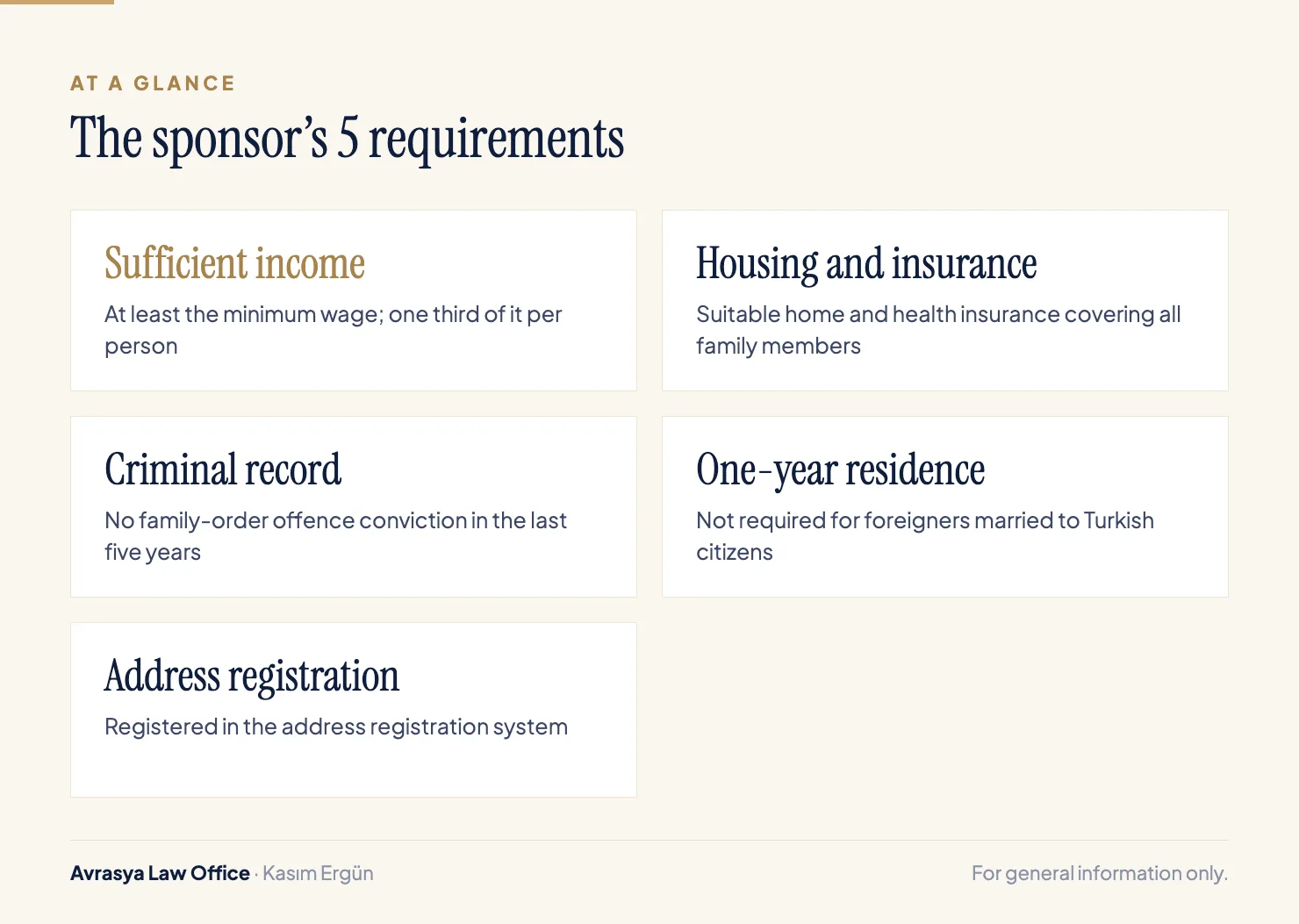
The sponsor requirements listed in YUKK Art. 35/1 are summarised in the table below:
| Requirement | What it involves | Legal basis |
|---|---|---|
| Sufficient income | A monthly income totalling no less than the minimum wage and no less than one third of the minimum wage for each family member | YUKK Art. 35/1-a |
| Housing and health insurance | Accommodation suited to the size of the family and meeting general health and safety standards, plus health insurance covering all family members | YUKK Art. 35/1-b |
| Criminal record | No conviction for offences against the family order in the last five years preceding the date of application | YUKK Art. 35/1-c |
| One year of residence | Having lived in Turkey with a residence permit for at least one year | YUKK Art. 35/1-ç |
| Address registration | Being registered in the address registration system | YUKK Art. 35/1-d |
How is the income requirement calculated?
Two criteria apply together under the income requirement: the total income must not fall below the minimum wage, and one third of the minimum wage must also be covered for each person. For a family of four consisting of the sponsor, the spouse and two children, this means an income of at least 4/3 of the minimum wage.
Who is exempt from the one-year residence requirement?
The one-year residence requirement does not apply to sponsors holding a work permit or a residence permit for scientific research, to Blue Card holders, or to foreigners married to Turkish citizens (Art. 35/2). For refugees and persons with subsidiary protection status in Turkey, the sponsor requirements may be waived (Art. 35/4).
What Requirements Must the Applying Spouse or Child Meet?
Not only the sponsor but also the foreigner requesting the permit must satisfy certain conditions (YUKK Art. 35/3). The applicant must:
- prove the family bond with the sponsor through information and documents such as a marriage certificate or birth certificate,
- show that they live with the sponsor or intend to live with the sponsor,
- not have entered into the marriage solely to obtain a family residence permit,
- be in a marriage where each spouse has reached the age of eighteen,
- not be among the foreigners who are not to be allowed entry into Turkey under YUKK Art. 7.
In addition, in residence permit applications, the passport or substitute document must remain valid for at least sixty days beyond the duration of the requested permit (YUKK Art. 21/2).
Where and How Do You Apply for a Family Residence Permit?
The general rule is that the application is made to the consulate in the country of which the foreigner is a national or in which they are legally present (YUKK Art. 21/1). The consulate forwards the file, together with its opinion, to the Presidency of Migration Management (Göç İdaresi Başkanlığı), and the application is decided within ninety days at the latest (Art. 21/4-5). If documents are missing, the review may be postponed until they are completed; the applicant is informed of what is missing (Art. 21/3).
Applying to the governorship from within Turkey is possible only in the exceptional cases listed in the Law (YUKK Art. 22). Examples of these exceptions include cases where it is not considered reasonable or possible for the foreigner to leave the country, requests for a permit matching a new purpose of stay because the basis of the current residence permit has changed, and applications made on behalf of a child born in Turkey to a parent holding a residence permit. In practice, foreigners legally present in Turkey book an appointment through the online e-İkamet system and submit their files to the provincial directorate of migration management.
Which documents should be prepared?
Although this varies with the specific case, the documents commonly requested are:
- the application form, passport and photographs,
- the marriage booklet or marriage certificate and the child’s birth certificate; for documents issued abroad, an apostille or consular legalisation together with a sworn translation,
- the sponsor’s income documents, identity or residence document and criminal record,
- a title deed or lease agreement and an address registration document,
- a document showing SGK (Social Security Institution) coverage or a health insurance policy,
- where custody is shared, a letter of consent from the other parent abroad.
A foreigner who comes to Turkey with a residence permit obtained from a consulate must have their address registered within twenty working days of the date of entry into the country (YUKK Art. 26/2).
Step-by-Step Family Residence Permit Roadmap
- Confirm eligibility: Verify that the sponsor and the applicant fall within the scope of Art. 34/1.
- Document the sponsor requirements: Prepare proof of income, housing, insurance covering the whole family, the criminal record and the address registration.
- Prepare the family-bond documents: Add an apostille or consular legalisation and a sworn translation to documents issued abroad.
- Gather evidence of a shared life: Keep a joint lease agreement, joint account, photographs and correspondence ready in the file.
- Apply to the correct authority: As a rule, apply to the consulate; if one of the exceptions in Art. 22 applies, apply to the governorship from within Turkey.
- Register your address: If you came with a permit issued by a consulate, register in the address registration system within twenty working days.
- Put the extension in your calendar: Plan the extension application for when sixty days remain before the permit expires, and do not miss the deadline.
How Long Is a Family Residence Permit Granted For and How Is It Extended?
The permit cannot exceed three years at a time, nor can it be longer than the sponsor’s own permit (Art. 34/1). The extension request must be submitted to the governorship from the date when sixty days remain before the permit expires and, in any event, before it expires. A foreigner who applies on time may continue to stay in Turkey with the document issued to them until a decision is made, even if the permit expires in the meantime (YUKK Art. 24/2).
A child holding a family residence permit may attend primary and secondary education until reaching the age of 18 without needing a separate student residence permit (Art. 34/4).
Does staying abroad affect the permit?
It does. Except for compulsory public service, education and health reasons, stays abroad exceeding a total of six months within one year, or a total of one year within the last five years, are deemed to interrupt residence; in that case, previous permit periods are not taken into account (YUKK Art. 28/1). Anyone considering a long-term residence permit or citizenship in the future should pay particular attention to this limit.
How Is a Sham Marriage (Marriage of Convenience) Investigated?
Where there is reasonable doubt before a permit is granted or extended, the governorship investigates whether the marriage was concluded solely to obtain a residence permit. If such a purpose is established, the request is refused and any permit already granted is cancelled (YUKK Art. 37/1). Checks may also continue after the permit has been granted (Art. 37/2).
In practice, the investigation may involve interviewing the spouses separately, a police inspection at the address and an assessment of documents showing a shared life. Contradictory information given by the spouses about each other, living at different addresses or not having a common language may be cited as grounds for suspicion. This is why it is important to gather evidence of a shared life in advance, such as a lease agreement for the same address, a joint bank account, photographs taken together, messages and witness statements.
One further consequence should not be overlooked: under Art. 37/3, periods spent on permits obtained through a sham marriage and subsequently cancelled are not counted towards the residence periods required by law.
When Is a Family Residence Permit Refused or Cancelled?
The Law groups into four headings the cases in which the permit will not be granted, will be cancelled if already granted, or will not be extended once it expires (YUKK Art. 36/1):
- the requirements set out in the first and third paragraphs of Article 35 not being met at all, or ceasing to be met later (for example, a drop in income or the end of cohabitation),
- the person not being granted a short-term residence permit either once the requirements have ceased to be met,
- the existence of a valid deportation or entry ban decision concerning the person,
- it being established that the permit is being used for purposes other than the purpose for which it was granted.
In applications made from within Turkey, before issuing a negative decision the governorship must weigh the person’s family ties in Turkey, how long they have lived here, the conditions in their country of origin and the best interests of the child (YUKK Art. 25/1). The decision is notified (tebliğ) to the foreigner, their legal representative or their lawyer, together with an explanation of how to exercise the right of objection (Art. 25/2). Decisions that fail to weigh these factors and rely on abstract reasoning provide an important ground for challenge in an annulment action.
What Should You Do If Your Family Residence Permit Is Refused?
After notification of a negative decision (refusal, cancellation or non-extension), the general remedy is to file an annulment action before the administrative court within 60 days (Administrative Procedure Law No. 2577 (İYUK), Art. 7). A stay of execution may also be requested in the petition (İYUK Art. 27).
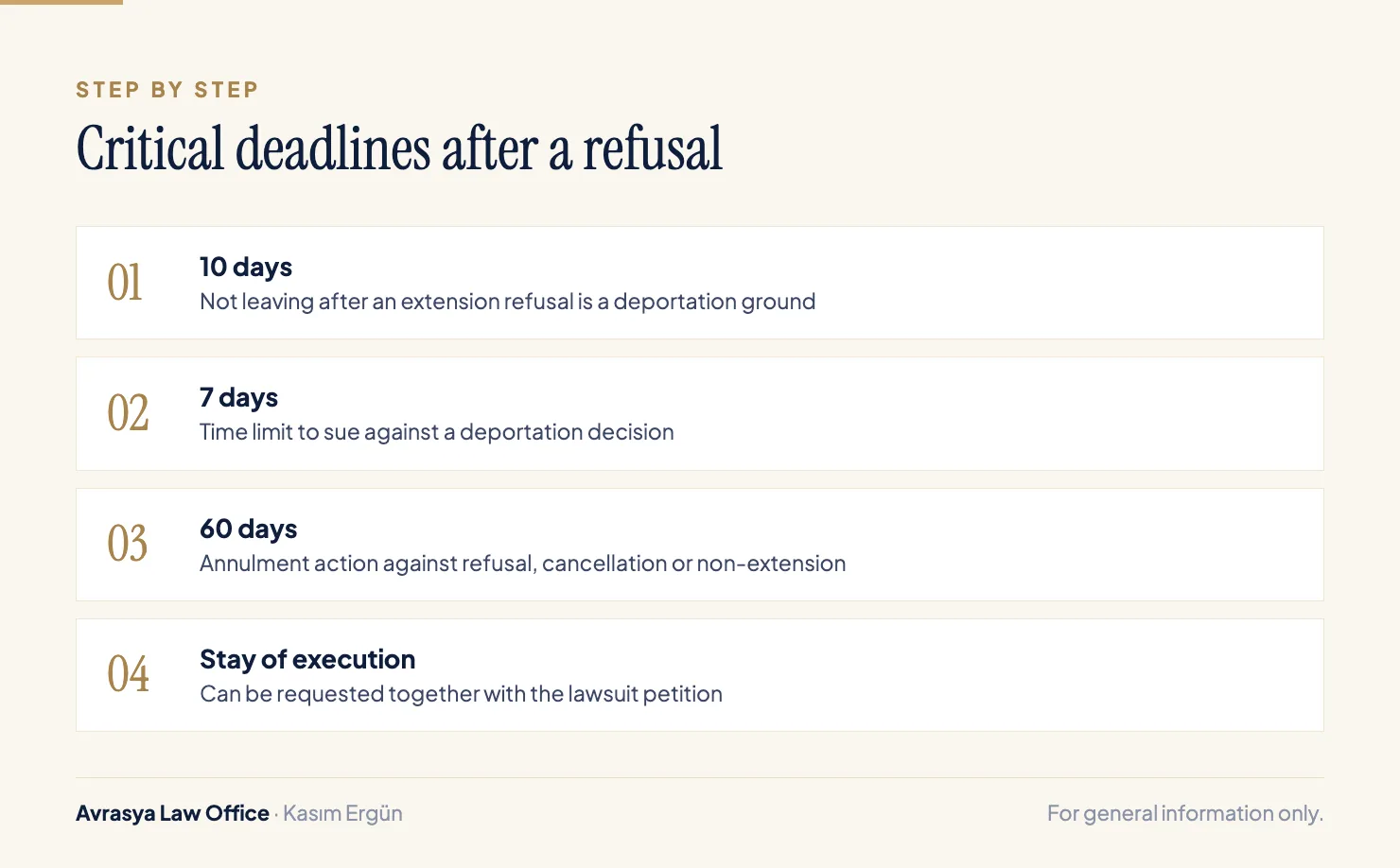
A foreigner whose extension application is refused and who does not leave Turkey within 10 days falls within one of the grounds for deportation (YUKK Art. 54/1-j). If a deportation decision was notified at the same time as the refusal, there are only 7 days to bring a lawsuit against that decision (YUKK Art. 53/3). This is why it is important to obtain legal support on the very day the notification is received. For more detail, see our guide to objecting to a residence permit refusal and filing an annulment action and our page on objecting to a deportation decision.
How Do Divorce, the Sponsor’s Death or a Child Turning 18 Affect the Permit?
Because the permit is based on the family bond, its basis is undermined when that bond ends. For these situations, the Law allows a transition to a short-term residence permit:
- Divorce: A foreign spouse divorced from a Turkish citizen may obtain a short-term residence permit if the time spent on a family residence permit has reached at least three years. This duration requirement does not apply to a spouse who, as established by a court decision, has been a victim of domestic violence (Art. 34/6).
- Death of the sponsor: Persons staying on this permit as dependants of the sponsor may obtain a short-term residence permit without any minimum duration requirement (Art. 34/7).
- Reaching adulthood: A person who has spent at least three years in Turkey on this permit and has turned 18 may, if they wish, request that the permit be converted into a short-term residence permit (Art. 34/5).
This transition does not require leaving the country; under Art. 22/1-f, the application can be made to the governorship from within Turkey. We also cover issues affecting foreigners going through a divorce separately on our divorce for foreigners page.
What Are the Common Mistakes in Family Residence Permit Applications?
- applying without showing the sponsor’s income in a regular and documented way,
- submitting health insurance that does not cover all family members or whose term is insufficient,
- submitting marriage and birth certificates issued abroad without an apostille or translation,
- going into a sham marriage investigation without evidence of a shared life,
- staying abroad for long periods and thereby causing an interruption of residence,
- submitting the extension request after the permit has expired,
- remaining in the country after a refusal without taking into account the 10-day period and the resulting risk of deportation.
Frequently Asked Questions
Can a foreign spouse married to a Turkish citizen obtain a family residence permit?
Yes. A foreigner married to a Turkish citizen may apply for a family residence permit. In these marriages, the requirement of having spent at least one year in Turkey on a residence permit does not apply (YUKK Art. 35/2). However, the requirements of sufficient income, housing suited to the size of the family, health insurance covering all family members and a clean criminal record still apply to a Turkish citizen sponsor.
How much income is required for a family residence permit?
The sponsor’s total monthly income must not be below the minimum wage and must not be less than one third of the minimum wage per family member (YUKK Art. 35/1-a). Since the minimum wage is set anew every year, the required amount changes as well. The calculation should be based on the minimum wage in force on the date of application, and the income should be presented as regular and documentable.
How many years is a family residence permit issued for?
A family residence permit is issued for a maximum of three years at a time. However, its duration can under no circumstances exceed the duration of the residence permit held by the sponsor on whom the application is based (YUKK Art. 34/1). If the sponsor’s permit is valid for a shorter period, the permit issued to the family member can be valid at most until that date.
When should I apply to extend my family residence permit?
The extension application must be submitted to the governorship from the point when sixty days remain before the permit expires and, in any case, before it expires (YUKK Art. 24/2). A foreigner who applies on time may stay in Turkey with the document issued to them until a decision is made, even if the permit expires in the meantime. An application made after the deadline does not offer this protection.
Can I work in Turkey with a family residence permit?
No, a family residence permit does not by itself confer the right to work. A family member who wishes to work in Turkey must obtain a work permit separately from the family residence permit. A foreign spouse who receives a job offer should plan the work permit process independently of the residence permit and should not start work before the permit is issued.
Does time spent on a family residence permit count towards a citizenship application?
Time spent on this permit can be taken into account when calculating residence. In calculating uninterrupted residence, all permits other than student residence permits are counted (YUKK Art. 28/2). By contrast, permits obtained through a sham marriage and subsequently cancelled are not counted (Art. 37/3). Turkish citizenship by marriage, on the other hand, is subject to separate requirements set out in Article 16 of Law No. 5901.
Will my family residence permit be cancelled if I divorce?
Because divorce ends the family bond on which the permit is based, the permit loses its basis. If your spouse is a Turkish citizen and the time you have spent in Turkey on this permit has reached at least three years, you may request a short-term residence permit. For victims of domestic violence established by a court decision, the three-year requirement does not apply (YUKK Art. 34/6).
Conclusion
The family residence permit is the main legal instrument that allows foreign spouses and children to live with their families in Turkey. A successful file depends on fully documenting the sponsor’s income, housing, insurance and criminal record requirements, gathering evidence of the genuineness of the marriage in advance and carefully tracking the extension timeline. In the event of a negative decision, the 60-day time limit for filing a lawsuit and the 7-day time limit that runs against a deportation decision must be considered together.
Our office, Euroasia Law Office in Bakırköy, works with Turkish and foreign clients on immigration and foreigners’ law matters. If you would like the file for your foreign spouse or child to be assessed, you can request a preliminary consultation through our contact page or review our Immigration and Foreigners Law page. Legislation and case law may change over time; this article has been prepared for general information purposes and does not constitute legal advice.
Related Guides
- What to Do If Your Residence Permit Is Refused
- Objecting to a Deportation Decision
- Turkish Citizenship Application
- Student Residence Permit in Turkey
- Work Permits for Foreigners